Santa María la Antigua del Darién was the first lasting Spanish town on the American mainland. Founded in 1510, it was burned by indigenous fighters in 1524. Fourteen years, then nothing but jungle.
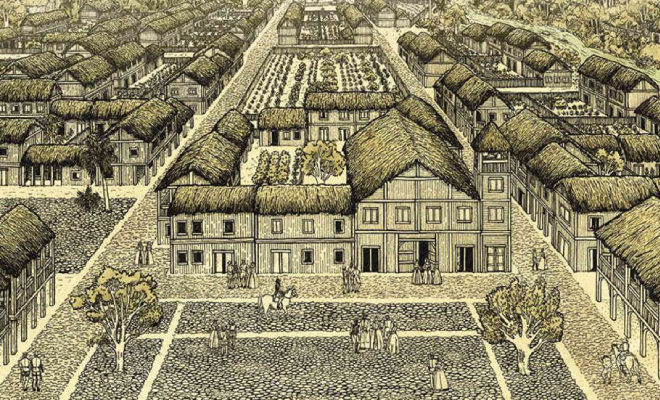
A council, not a camp
Vasco Núñez de Balboa and Martín Fernández de Enciso picked the western shore of the Gulf of Urabá, in what is now Colombia's Chocó department, where the Darién jungle is cut by rivers and swamps. They wanted a place whose people traded more readily than they fought with poisoned arrows. The town was meant to govern, not to camp. A cabildo, the city council, was soon naming mayors and building the ordinary machinery of a Spanish town.

A street grid under the canopy
Digs since the early 2010s, using satellite images, ground-penetrating radar, and ordinary trenches, have redrawn Santa María as a working city. Streets, house blocks, workshops, a blacksmith's forge, water intakes, and a yard where musket balls were cast. At times several thousand people lived in the town, and an Atlantic port moved goods, settlers, and news.
Expeditions out of Santa María led to Balboa's sighting of the Pacific in 1513.
The same jungle that hid the town also wore it down. Mosquito-borne disease, locusts and hunger, and a strange wave of sleepiness among the colonists that researchers still cannot pin down, whether to a toxin or to something in the place itself.

By 1520 the crown had moved the capital of Castilla del Oro south, to the future Panama Viejo. In 1524 indigenous fighters attacked and burned what was left.
Historians lost the site for centuries. The first search parties went in during the 1960s. Work since 2013 turned it into one of the important digs in Latin America. Colombia listed it as culturally significant in 2015 and made it a national archaeological park in 2016.
Under the Spanish grid, excavators found a large pre-Columbian settlement of the Cueva people, dated to the 12th century. The town that lasted 14 years sits on a much older one.