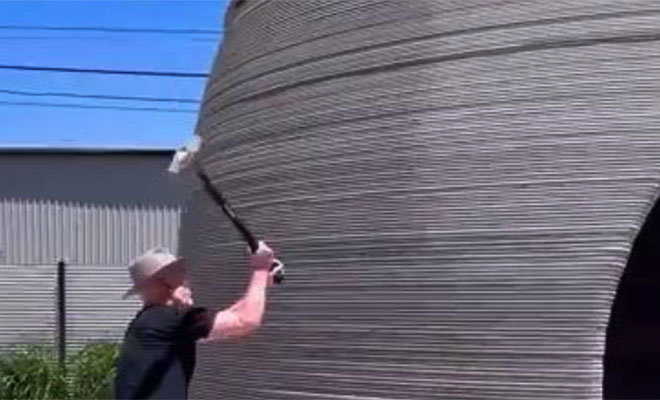
Construction 3D printing is moving fast, but plenty of people still doubt it. Layered cement looks fragile, as if a serious hit would bring the wall down. To settle that argument, one experimenter picked up a heavy sledgehammer and swung full force at a finished printed house wall — and the crash test surprised a lot of viewers.

In the viral clip, the man puts his whole body into a huge hammer strike on a freshly printed wall. Ordinary brick or cinder block would almost certainly crack or shatter under that blow.
With the 3D-printed house, the tool bounced off with a ringing clang and left no visible mark. The layered surface that looks vulnerable turned out tougher than solid stone.
Why printed houses hold up so well
That strength comes from how the printer works and what goes into the mix.
A construction printer is not filled with ordinary mixer concrete. It runs complex composites with plasticizers, fiberglass, and microfiber. Those additives set in minutes and resist not only compression but also tension and bending.
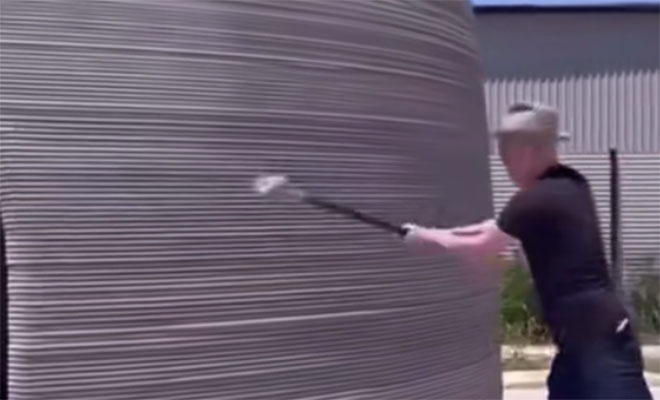
The printer lays continuous beads of concrete. The lower layer is not fully dry before the next one lands. Chemical diffusion kicks in, and the wall becomes one solid block where layer boundaries disappear at the molecular level.
Look inside a printed wall and it is rarely solid. The printer draws internal ribs in a honeycomb or zigzag pattern. That hollow, partitioned structure absorbs and spreads the energy of a point impact, sending vibration through the whole building.
Where the technology is headed
Structural tests show printed builds outperform traditional brickwork by roughly a third. They can take not only vandals with sledgehammers, but strong hurricanes and even earthquakes.