A knife really can start cutting better after a few strokes on newspaper. The reason has nothing to do with the famous «graphite in printing ink.» The old kitchen trick works by honing the edge, so it suits a blade that is still sharp but no longer cuts as cleanly.
What newspaper does to a knife
During use, the thin cutting edge gradually picks up microscopic irregularities. The knife may still look sharp, but the cut becomes less clean.
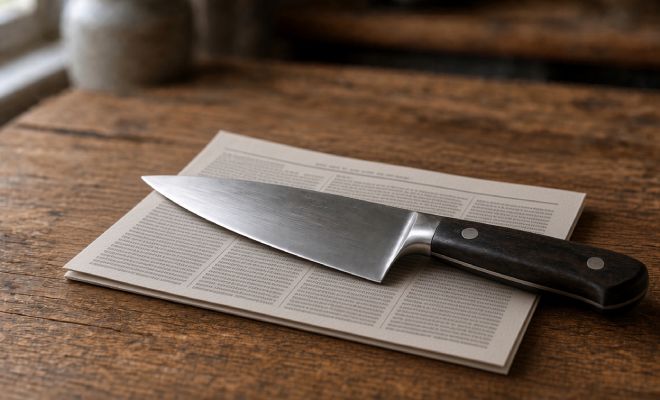
If you draw such a blade across folded newspaper several times, the soft surface helps slightly straighten and polish the edge. That is why the knife may again slice paper, vegetables, or other foods more easily.
This is honing rather than sharpening in the usual sense.
What about the graphite?
Here is where the old life hack gets interesting. For decades people explained it simply: black printing ink contains graphite, and that is what sharpens the metal.
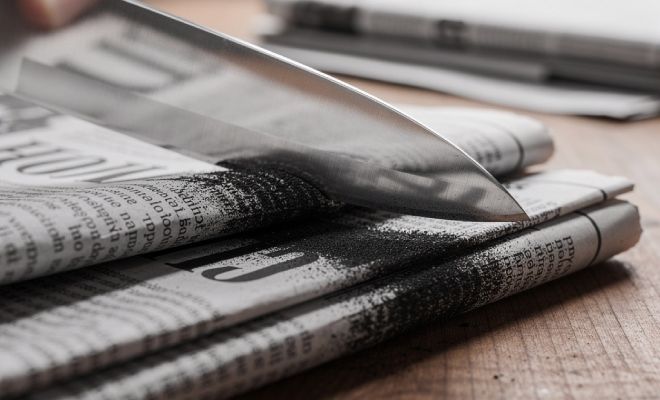
That is not quite right. Black printing inks do use carbon pigments, but calling them graphite is misleading. And newspaper itself is not a full abrasive capable of restoring a badly dulled blade.
So the trick is not «secret Japanese graphite,» but a very gentle treatment of an edge that is already formed.
How to try it
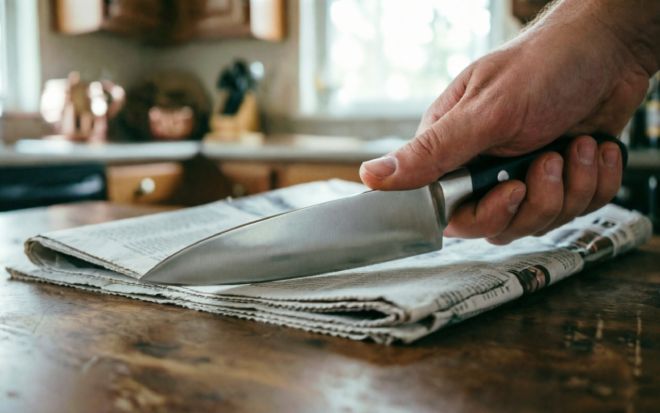
Fold several sheets of newspaper and place them on a flat surface. Draw the knife across the paper with the cutting edge away from you, keeping your usual sharpening angle. Make a few light passes on each side.
There is no need to press hard. Afterward, wash the knife and test it on paper or food.
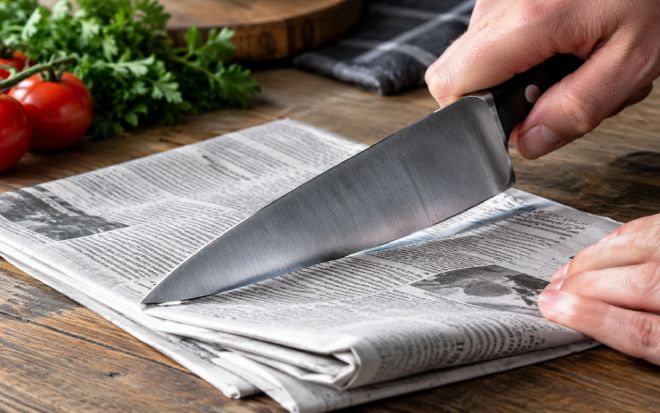
There is a simple test: if you notice no difference after a few passes, newspaper will not help.
A seriously dull knife cannot be sharpened with newspaper. For that you need a real abrasive that removes metal and rebuilds the edge.
But a knife that has simply lost its former bite can sometimes be brought back to life with newspaper. The old advice works — it was just described for decades with the wrong word.