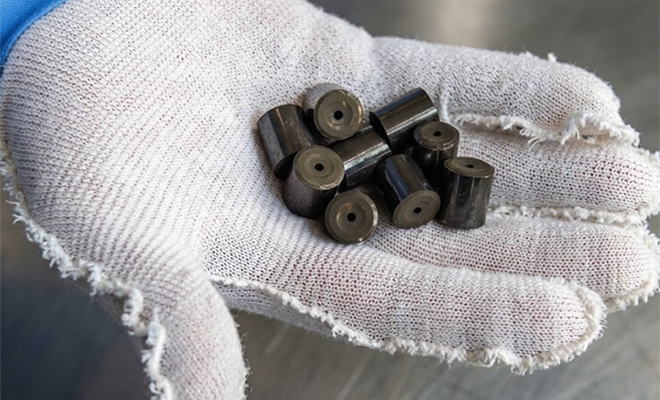
Nuclear fuel looks unimpressive up close. A tiny gray cylinder only a bit larger than a fingernail sits easily in a palm and weighs just a few grams. It is hard to believe one pellet can store as much energy as a railcar of coal.
How much energy sits in one pellet
To grasp the energy density, compare one standard uranium pellet of about 4.5 to 5 grams with fossil fuels.
Fully burned, one pellet releases about as much heat as:
- 400 kg of coal (nearly half a ton of good quality fuel);
- 350 liters of oil or diesel;
- 400 cubic meters of natural gas.
In everyday electricity terms, one pellet delivers around 2,000 kWh. That is enough for a typical apartment to run lights and appliances continuously for about half a year.
Why nuclear fuel is so much more efficient
The leap comes from a basic difference between chemical and nuclear reactions.
Burning coal, gas, or wood is a chemical reaction: atoms rearrange and swap electrons. Molecular bonds break and release a relatively modest amount of heat.
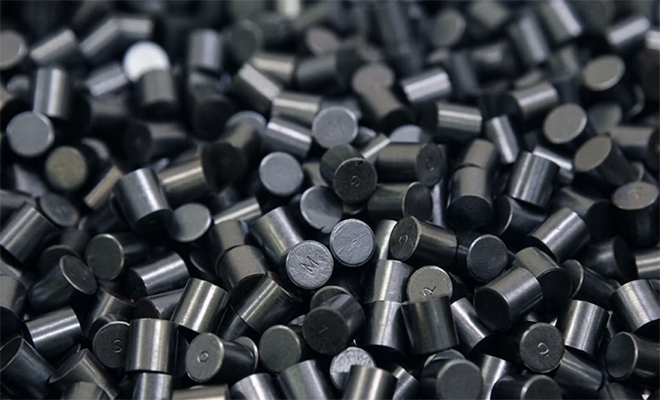
In a reactor the process is nuclear fission. When a neutron hits an unstable uranium-235 nucleus, the nucleus splits in two. The strongest nuclear bonds holding protons and neutrons together break. Energy from splitting one atomic nucleus is roughly 200 million times the energy from burning one carbon molecule.
How pellets become electricity
On its own, one pellet is relatively safe to handle with protective gloves and little radiation risk. To put it to work, engineers pack pellets into complex assemblies.
Loaded into tubes: Hundreds of uranium pellets are stacked inside sealed tubes of zirconium alloy. Those become fuel rods.
- Assembled into bundles: Dozens of rods form fuel assemblies that go into the reactor core.
- Reaction and heat: A controlled chain reaction starts. Pellets heat to hundreds of degrees and warm the water around them.
- Turbine spin: Boiling water or high-pressure steam drives a giant turbine that feeds the grid.
Environment and the main upside
While a uranium pellet is working, it emits no carbon dioxide, soot, or heavy metals into the air, unlike coal or fuel oil.
The caveat is spent fuel. After years in a reactor a pellet is only partly burned, but it accumulates radioactive fission products. Because the volume is compact, decades of plant waste can be isolated securely or reprocessed so valuable uranium returns to the cycle.