Mercedes G-Class spent nearly half a century building its reputation as a luxury off-roader. TANK 700 decided that was long enough. Here you get a ladder frame, low-range gearing, and 517 hp — alongside massage seats, a "starlight" headliner, and an interior you don't want to leave. It's a genuine automotive oxymoron: designed as if one engineer had just come back from the trail and the other had returned from Milan Fashion Week. The interesting part is that they didn't fight. We look at what came out of this odd pairing — and why the TANK 700 is compared to the G-Wagen at all.

Size Matters Here
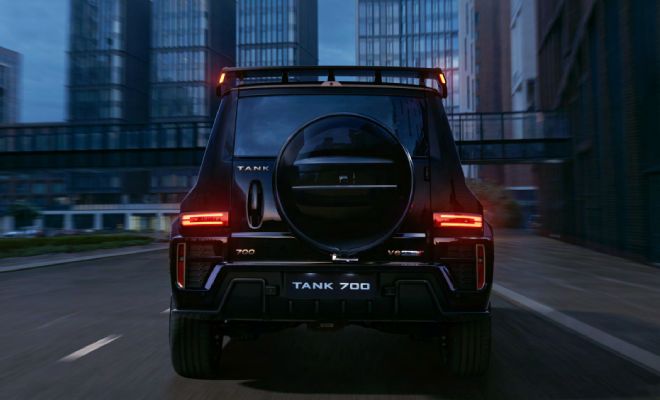
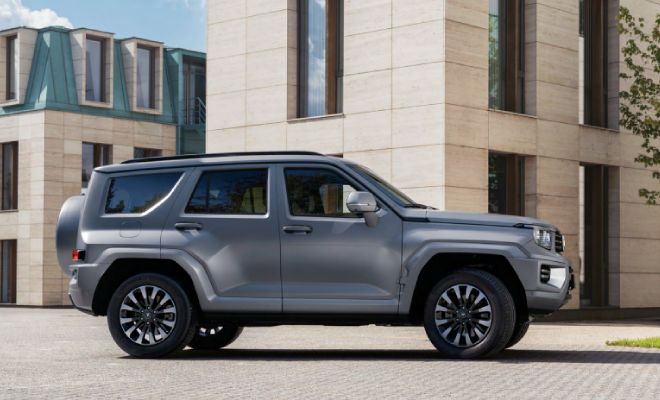
The TANK 700 is hard to mistake for a compact urban crossover. It's 5.09 meters long, over two meters wide, and nearly two meters tall. Subtle it is not: a high hood line, massive grille, large lighting elements, and big wheels create a vehicle that takes up space not only in a parking spot but in your field of vision.

Top trims add laser headlights, 22-inch wheels, and power-deployable side steps. A spare wheel is mounted on the tailgate — so even with all the luxury, TANK hasn't given up the hallmarks of a serious off-roader.
The Cabin Feels More Like a Lounge
Inside, the story changes completely. The driver faces a 12.3-inch digital instrument cluster; the central infotainment screen measures 16.2 inches. TANK didn't hand everything over to touch controls either — physical buttons remain on the dashboard.
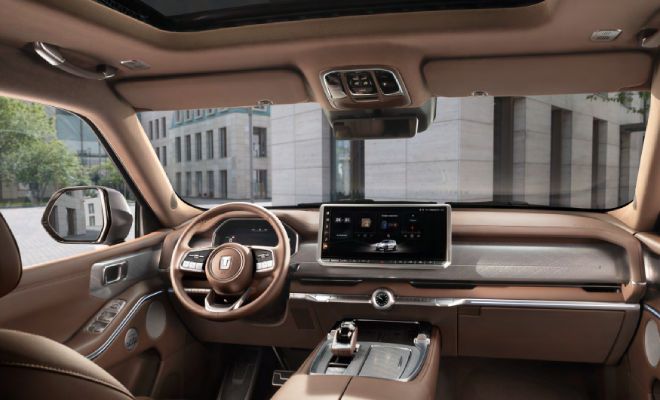
The trim fits the class. Nappa leather, ambient lighting, and double glazing. But the main event is behind the front seats.
The second row is built for a long journey, not a quick airport run. The seats offer power adjustment, heating, ventilation, and massage. The center armrest has its own touchscreen; the rear doors get power sunshades. Three-zone climate control means passengers don't have to negotiate temperature with the driver.

There are aviation-style headrests too — as if the big SUV briefly decided to become business class.
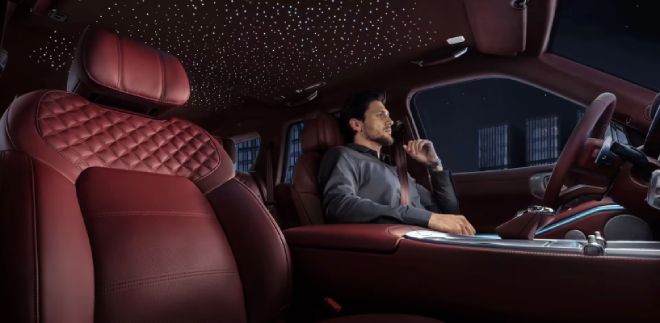
At night, the ceiling lights up with "starry sky" and "shooting star" effects. A 16-speaker audio system handles the soundtrack. The second row feels less like a ordinary bench and more like a separate lounge.
And All of This Sits on a Frame
Things get most interesting when you remember the TANK 700 isn't just a huge luxury crossover.
It uses a ladder-frame chassis, Torque on Demand all-wheel drive, and low-range gearing. Depending on trim, you get conventional or air suspension. On air-sprung versions, ground clearance reaches 325 mm, and the claimed wading depth is 900 mm.

The result is an unusual pairing. The same vehicle can carry passengers under a "starry sky" — and a few hours later end up where a low-clearance crossover would rather not go.
Three Liters, Six Cylinders, and a Hybrid
The base TANK 700 powertrain centers on a twin-turbo 3.0-liter gasoline V6. The engine makes 354 hp and 560 Nm, paired with a nine-speed automatic. Zero to 100 km/h takes 8.8 seconds.
On the hybrid, the same V6 works with an electric motor and a 37.1 kWh battery. System peak output is 517 hp; combined torque is 800 Nm. That TANK hits 100 km/h in 5.9 seconds.
For a three-ton ladder-frame off-roader, the number is almost surreal — especially when you consider the hybrid can cover up to 100 km on electricity on the NEDC cycle.
Fuel economy comes with a caveat. The manufacturer claims 2.2 L/100 km combined on NEDC, but that figure includes electric energy use. Without it, the hybrid is rated at 10.6 L/100 km. The gasoline TANK 700 returns 12.5 L/100 km combined on the same cycle.
Why People Mention the G-Class Alongside It
The Mercedes G-Class comparison isn't random. Both use a ladder frame and all-wheel drive and aren't meant for pavement alone. But the approach differs.
For decades the G-Class kept its recognizable silhouette and link to the original military off-roader, gradually becoming an expensive city and highway machine. The TANK 700 arrived in a different automotive era. Buyers now expect serious geometry and high ground clearance from a big SUV — and also quiet, screens, massage, and a hybrid powertrain.

So the TANK 700 is interesting not as a G-Wagen clone but as its own attempt to merge two worlds that used to stay far apart. You can have a frame and low range — then move to a massage seat. You can drive off-road by day and switch on the "starry sky" over the second row at night.
That combination starts at 10,199,000 rubles for the TANK 700 Premium with the stated trade-in terms. Techno Premium is from 11,399,000 rubles; Edition One from 12,599,000 rubles. These are manufacturer-program prices — not a straightforward retail sticker without purchase conditions.
In the end, the TANK 700 is hard to file under one familiar category. By construction it's a serious ladder-frame off-roader; by cabin equipment it already plays in the executive league; the hybrid adds unexpected performance to the formula.

Under the leather, lighting, and massage seats, it's still a machine with low-range gearing, generous clearance, and a spare on the tailgate. That mix may be exactly what makes the TANK 700 the strangest participant in any conversation about big luxury off-roaders.
Specifications
Dimensions, L/W/H, mm: 5090 × 2061 × 1952
Curb weight, kg: 2850–2890 for gasoline versions; 3190 for hybrids
Engine: 3.0 L twin-turbo gasoline V6; hybrid version adds an electric motor
Power, hp: 354 hp (gasoline); 517 hp system peak (hybrid)
0–100 km/h, sec: 8.8 (gasoline); 5.9 (hybrid)
Drivetrain: AWD, Torque on Demand, with low-range gearing
Fuel consumption, L/100 km: 12.5 (gasoline); 2.2 (hybrid on NEDC including electric energy)