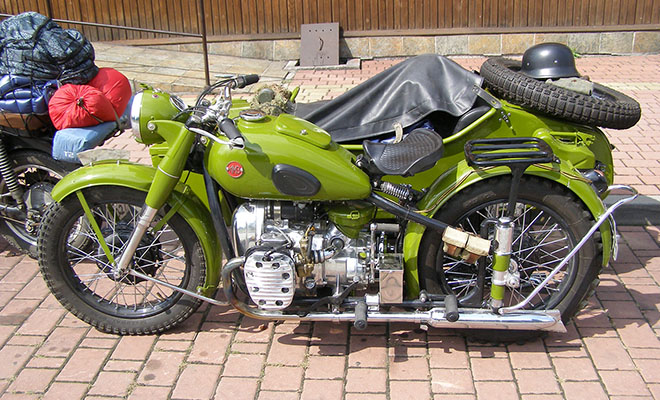
Few Soviet machines match the charisma and longevity of the heavy M-72 motorcycle. As a Red Army workhorse in the Great Patriotic War, the three-wheel titan shaped domestic bike building for decades. Its DNA later fed the cult civilian Ural and Dnepr lines. The legend started with a tightly classified op.
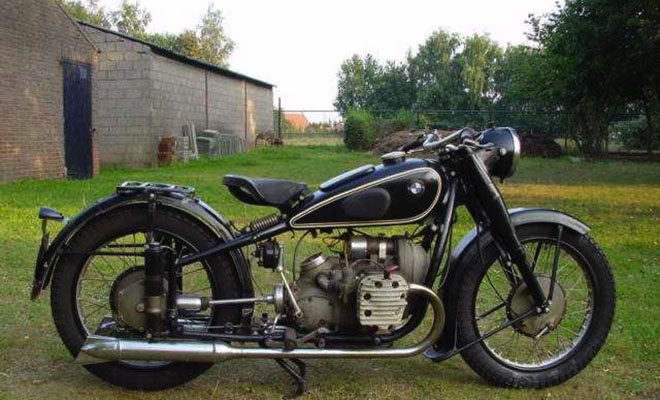
The German trail: BMW gets a Soviet address
By the late 1930s Moscow knew the army needed a tough, long-legged bike for recon, signals, and moving troops. Light Soviet models were not enough. The ideal sat in Germany: the new army BMW R71.
Buying a military license from a future enemy was impossible, so intelligence ran a clean workaround:
- Through cutouts in neutral Sweden, five production BMW R71s were bought legally.
- They were moved to Moscow and stripped to the last bolt at the Moscow Motorcycle Plant (MMZ).
- Under engineer Pyotr Serdyukov the team reverse-engineered everything: alloys, heat treat, casting details.
In spring 1941 a prototype tagged M-72 got Stalin’s approval and entered series production.
Front-line titan
War forced evacuation of Moscow plants. Main M-72 production rose on a former brewery site in Irbit in the Urals, the birth of IMZ. Conditions were brutal; by 1942 the line was running hard.
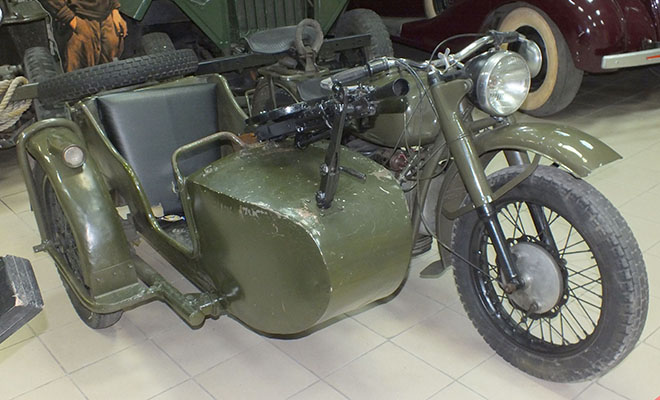
At the front the M-72 was treated less like a bike and more like a mobile fire point. Sidecars took Degtyaryov DP-27 machine guns, DShK heavies, or even an 82 mm mortar.
A low center of gravity from the flat-twin made it freakishly stable off-road: mud seasons, sand pits, even towing light artillery that had bogged down.
Built to be fixed in a field
Popularity came from serviceability and climate toughness. German engineering stayed; tolerances and materials got more brutal.
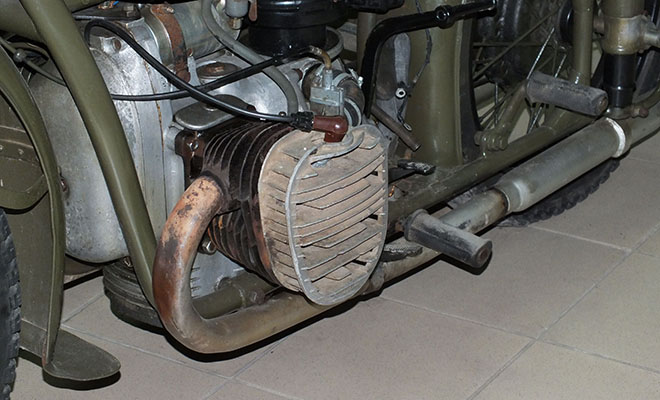
Heart of the machine: a 746 cc four-stroke flat twin making a honest 22 hp. Sidevalve layout ran on poor gasoline and cheap oil.
- Shaft drive instead of a chain, so mud, sand, and rocks did not snap a drive like a typical bike of the era.
- Duplex steel frame rated around 300 kg payload; in practice four or five fully kit soldiers piled on.
Peace, then the wider world
After 1945 the M-72 shifted to state service. Into the mid-1950s it stayed scarce special transport for police, medics, cash escorts, and big collective farms. Private citizens could not buy one; each unit sat on military books. Later engineers spun Ural, then Dnepr, from the same root.
The trail went abroad. In the 1950s full drawings and tooling went to the People’s Republic of China. There the veteran lived on as the Chang Jiang CJ750 for the PLA into the late twentieth century.
Soviet production ran to 1960, more than 400,000 built. It became the base Irbit and Kiev engineers used for the whole heavy Soviet bike line, turning a wartime reverse-engineered concept into the face of Soviet moto culture.