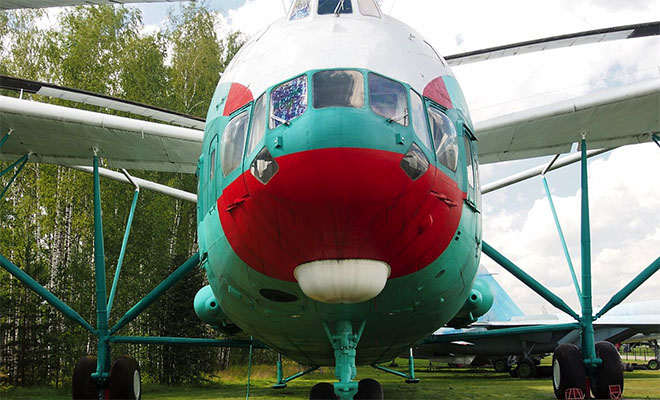
At the height of the Cold War, Soviet leadership gave engineers an unprecedented brief: a helicopter that could haul intercontinental ballistic missile components weighing up to 40 tons into remote regions. Mil Design Bureau answered with the V-12 (Mi-12), the heaviest and highest-lift helicopter in aviation history. In size it outclassed Boeing 737 airliners, and nobody elsewhere ever duplicated the layout.
Why the V-12 existed
In the early 1960s the Soviet Defense Ministry needed a quiet, fast way to move strategic loads. Building heavy-transport runways in taiga or desert was slow, expensive, and easy to spot. Rail did not always reach the job.
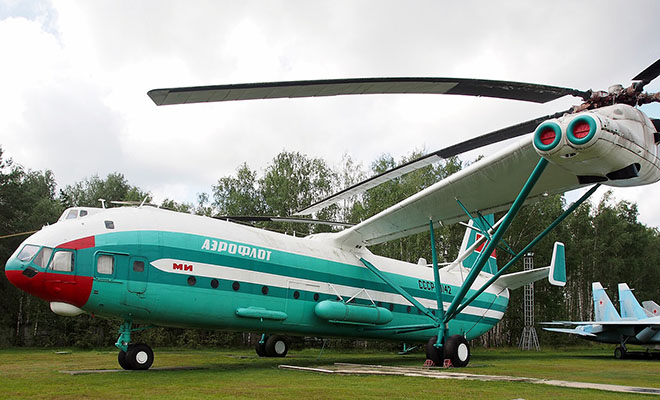
The country needed a machine that could lift armor or strategic launch gear off an airfield and drop it on unprepared forest clearings. In 1959 Mikhail Mil’s bureau got the order for a clean payload of about 30 to 40 tons. The existing flagship Mi-6 lifted roughly half that.
How the V-12 was built
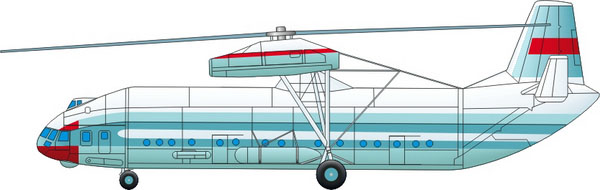
A classic single main rotor with a tail rotor could not scale to this size. Mil chose a twin side-by-side rotor layout. Two 35-meter rotors sat on a reverse-taper wing (wider toward the tips) for airflow and stability.
The numbers still look extreme:
- Size: fuselage about 37 m long; tip-to-tip span over 67 m; height about 12.5 m, the scale of a three-story building or a mainline airliner.
- Power: four upgraded D-25VF engines totaling about 24,000 hp, synchronized through a complex central gearbox.
- Capacity: a vast hold with a rear ramp copied from the An-22, for up to 196 people or outsized army containers at a max takeoff weight of about 105 tons.
- Crew: a two-level cockpit: pilots, flight engineer, and radio on the lower deck; navigator above. Cruise speed about 240 km/h.
Records and Le Bourget
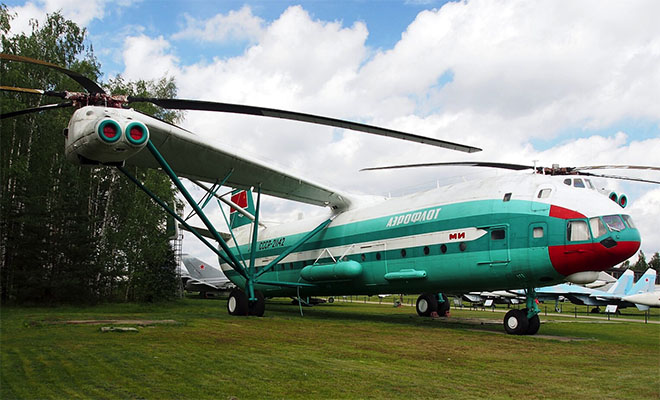
First flight of the prototype was 10 July 1968. An earlier lift attempt a year before ended in a hard landing and gear damage from an oversensitive control system that engineers had to redesign.
On 6 August 1969, test pilot Vasily Koloshenko’s crew set an absolute world record: 44.2 tons lifted to 2,255 meters. That helicopter payload mark still stands.
In 1971 the Soviet super-helicopter flew itself to Europe and stunned the 29th Paris Air Show at Le Bourget. Foreign experts called the V-12 an engineering masterpiece; Mil Design Bureau took the Igor Sikorsky Prize.
Why the program stopped
Despite proven performance, the V-12 never entered mass production. By the early 1970s the reasons it was built had shifted:
- Doctrine: Strategic Rocket Forces moved to silo launchers and lighter mobile ground systems. Airlifting 40-ton missiles was no longer the priority.
- Infrastructure: basing a 105-ton helicopter needed special pads, huge costs, and scarce specialist crews.
- Economics: heavy transports plus expanding rail covered army and industry needs more efficiently.
Only two prototypes were built. The work was not wasted: synchronizing ultra-powerful plants and giant gearboxes fed the later Mi-26, still the largest production helicopter in the world.