Casio unveiled an $80,000 G-Shock: the limited MRG-D5000 in blue sapphire, only 20 pieces. It looks like the cult watch finally left practical gear for high luxury. The more interesting detail is not the price. A brand famous for being nearly unbreakable is now built from a material that does not love hard hits.
A G-Shock that suddenly became luxury
For decades G-Shock sold a simple idea: a good watch should survive drops, water, random knocks, and the mess that happens when no careful owner is around.
Casio decided to see how far that idea could go.
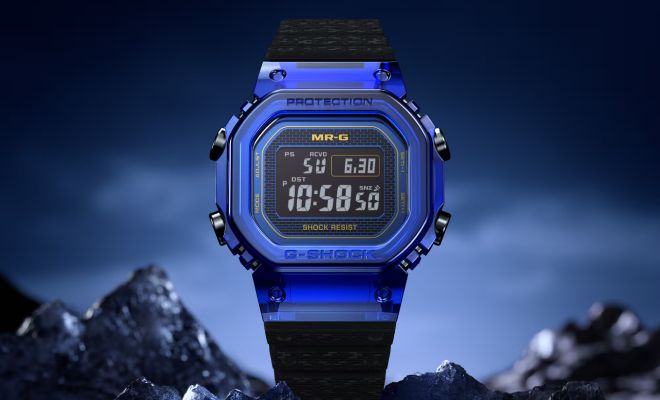
That led to the MRG-D5000 Blue Sapphire, the first MR-G with a case and bezel using blue sapphire crystal. The run is limited to 20 pieces worldwide. Each caseback is numbered from 1/20 to 20/20.
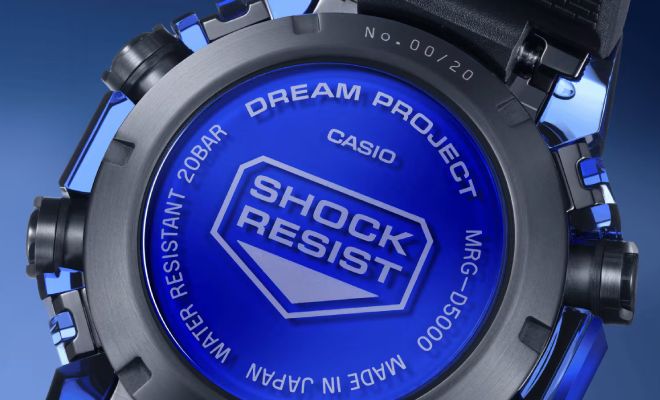
A regular G-Shock looks like engineers were told to make a watch that could survive the apocalypse. The MRG-D5000 looks like someone called a jeweler afterward.
Eight years against fragility
Sapphire is almost ideal for hardness and scratch resistance. The catch: hardness is not impact toughness. Under a sharp hit, sapphire can crack.
For G-Shock that is like giving a tank crystal armor and then asking the engineers to keep the old specs.
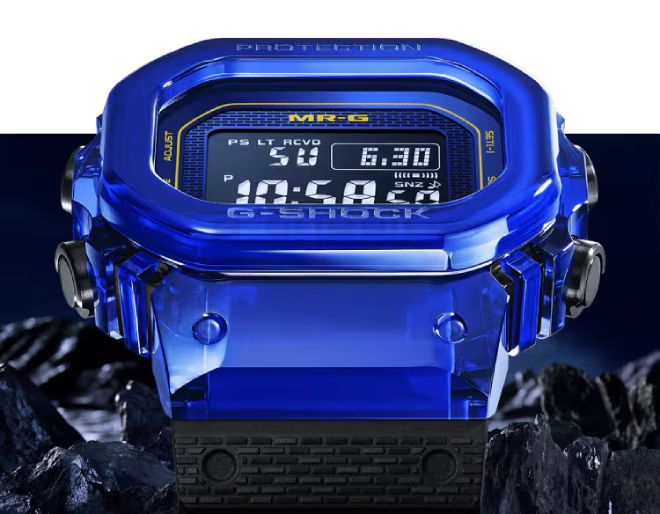
Casio did not argue with physics. It redesigned around it. A special Multi-Guard Structure splits the case into parts that share impact energy. Screws were removed where they could put extra stress on the sapphire.
The work took years. The MRG-D5000 grew from sapphire G-Shock experiments that started in 2018. In 2026 the idea became a production watch, if only in a tiny run.
Blue sapphire, gold, and Japanese perfectionism
The blue sapphire is not a mere accent. Blanks grow for months, then sections with the right color and clarity are chosen. The deep blue makes an ordinary G-Shock case look ready for a private auction.
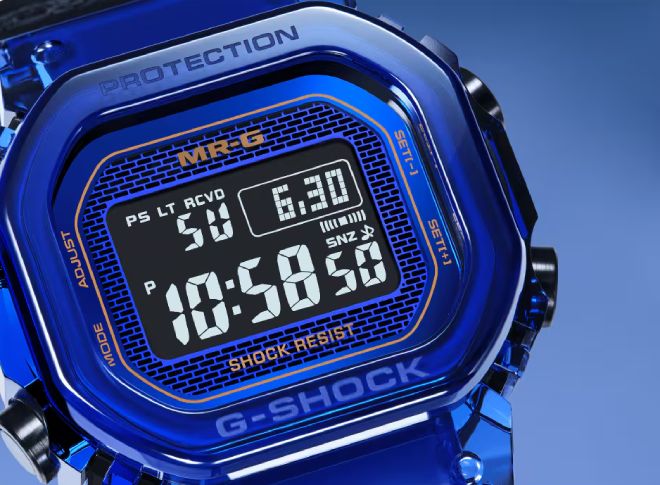
The dial keeps the famous brick pattern from early G-Shock models, but some markings are 24-karat gold. The strap uses Dura Soft material; the clasp is titanium. The case mixes titanium and sapphire crystal.
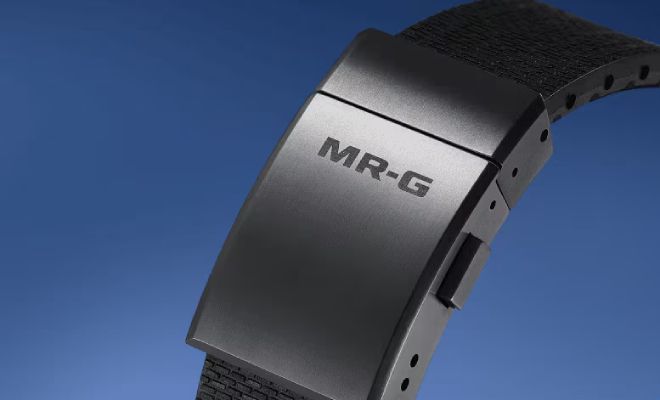
Even so, the MRG-D5000 is not a useless jewel. It still has Tough Solar charging, Multi Band 6 radio sync, shock resistance, and 200-meter water resistance. Size is 51.1 × 43.2 × 16.5 mm; weight is 121 grams.
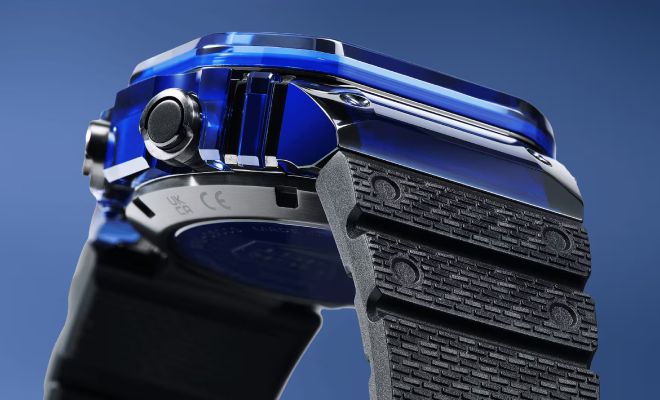
So it is still a G-Shock. Just one that costs about as much as a premium car and probably changes how you feel about bumping a doorframe.
$80,000 is no longer about telling time
At $80,000 the MRG-D5000 becomes a collectible. The Japanese price is about ¥11 million, and the global run is only 20 pieces. You cannot simply walk in with a card: Casio uses registration and buyer screening.
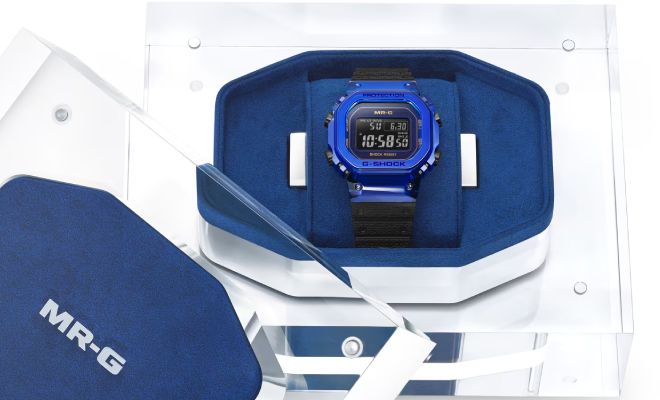
The project name fits: Blue Rose Project. In Japanese culture a blue rose stands for something almost unreachable. The metaphor lands well. Casio spent years making a hard, brittle material work inside a design ruled by shock resistance.
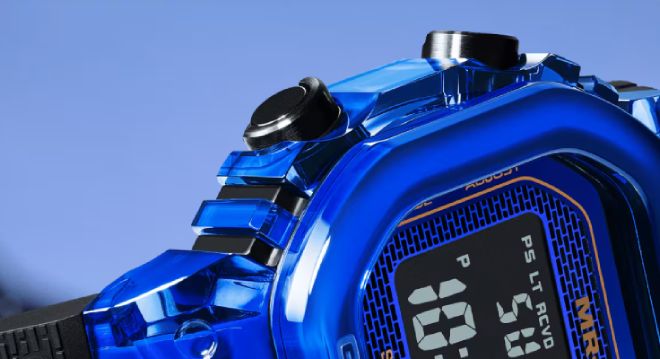
What they got is a watch that no longer needs to prove it is practical.
People buy a regular G-Shock for confidence it will outlast the owner, a vacation, and a few bad apartment renovations. They buy the MRG-D5000 for something else: a small Japanese engineering paradox worth $80,000 on the wrist.
The module still shows time like far cheaper G-Shock models.
But at $80,000, watching the face of someone who asks the price is often more interesting than watching the dial.