A fall from height without a parachute almost always means death. And yet aviation history records rare cases when people survived free fall from kilometer altitudes. That raises a question: is there even the slightest chance?
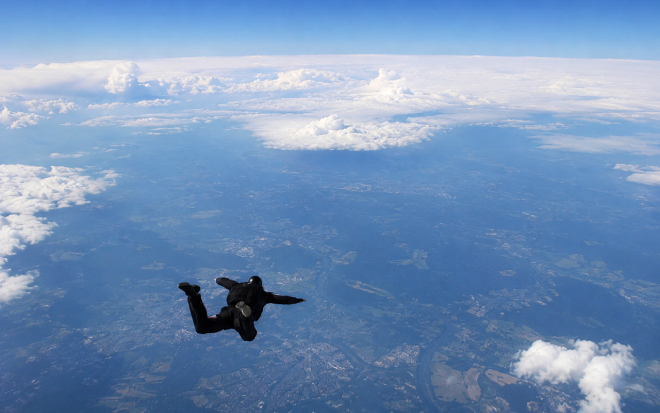
From a physics standpoint the process looks predictable. A person accelerates quickly under gravity and within a few seconds reaches a terminal speed of about 190 to 200 km/h. After that, acceleration almost disappears. Air resistance balances the force of gravity, and the fall becomes steady.
But what decides the outcome is not the flight itself. It is the moment of stopping.

What kills is not speed, but the sudden end of motion. When the body stops instantly, the overload becomes incompatible with life. If braking stretches even a little, the situation changes, though that still gives no guarantee of survival. Here the main paradox of the topic appears.
History holds isolated cases of people surviving a fall without a parachute. The best-known example is Vesna Vulović. In 1972 she survived after an aircraft breakup and a fall from more than 10 kilometers. The case is still considered the highest documented survival without a parachute.

Photo: Wikimedia Commons
Another example involves American military gunner Alan Magee. He fell from a damaged bomber during World War II and survived hitting a glass railway station roof. The structure partly softened the impact and changed how the stop happened.
What links these stories is not luck in the everyday sense, but an extremely rare mix of conditions. That can mean intermediate obstacles, collapsing structures, snow, trees, or soft ground: anything that can lengthen stopping time even by fractions of a second.

That microscopic change in braking time is what becomes the decisive factor between life and death.
It is important to understand that such cases do not offer a practical model of behavior. They cannot be repeated or planned. They arise as exceptions to physical rules, not as a disproof of them.
Surviving a fall without a parachute in real conditions is almost impossible. Exceptions exist, but they do not change the rule. They only underline it.