The global ranking of the planet's largest submarines has long been a closed club of two superpowers. Russia holds three of the four top spots outright. The colossal size of Russian boats is hard to picture because the main hull stays below the surface. Even so, some of them approach the scale of modern cruise liners.
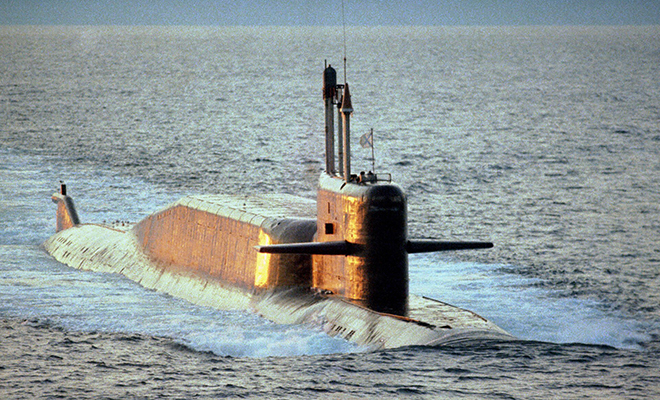
Project 941 Akula (NATO reporting name: Typhoon)
A Soviet nuclear cruiser officially listed in Guinness World Records as the largest submarine in history. Its giant size was a forced answer to domestic weapons: Soviet R-39 solid-fuel missiles were extremely powerful, but also huge and heavy (about 90 tons each), so the ship had to be built around them.
- Dimensions: length 172.8 m, beam 23.3 m, draft 11.2 m.
- Displacement: surfaced 23,200 tons, submerged 50,000 tons.
- Crew: 160 people (including 52 officers).
- Main armament: 20 silos for heavy R-39 intercontinental ballistic missiles.
- Features: the submarine is built on a unique catamaran principle: under the light outer hull sit two parallel pressure hulls. That gave the boat extreme survivability and a vast internal volume.
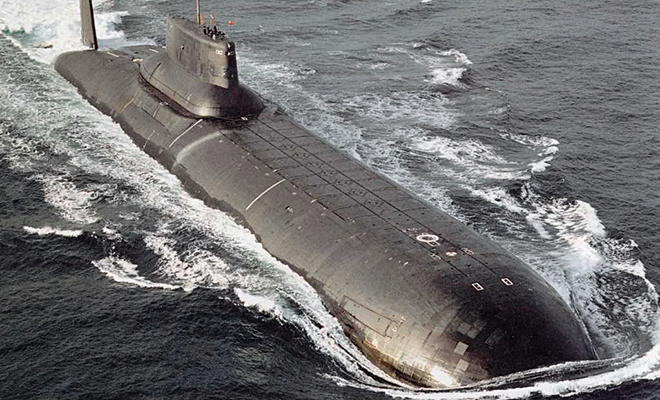
For the high level of comfort, sailors called it a floating hotel: the boat had a sauna, gym, solarium, and even a small pool. Akula was designed for Arctic patrol and could break through meter-thick ice when surfacing.
K-329 Belgorod (Project 09852)
A Russian special-mission nuclear submarine that holds the world record as the longest submarine on the planet. It is a one-off project with no direct equal elsewhere.
- Dimensions: length 184 m, beam 18.2 m, draft 9.2 m.
- Displacement: surfaced 14,700 tons, submerged about 30,000 tons.
- Crew: about 110 to 120 people (exact figures are classified).
- Main armament: six strategic Poseidon unmanned underwater vehicles.
- Features: rebuilt from an Antey-class cruiser by splicing in an extra 18-meter section. It carries out secret missions under the Main Directorate of Deep-Sea Research (GUGI).
Belgorod serves as a giant mothership: nuclear deep-diving mini-stations can be mounted under its keel for work on the ocean floor, while the bow holds large launch systems for Poseidon nuclear robot super-torpedoes.
Project 955 / 955A Borei
A modern class of Russian fourth-generation strategic nuclear ballistic-missile submarines that form the backbone of the country's sea-based nuclear forces. Replacing the Soviet titans, these boats are more compact yet far more dangerous thanks to stealth technology.
- Dimensions: length 170 m, beam 13.5 m, draft 10 m.
- Displacement: surfaced 14,720 tons, submerged 24,000 tons.
- Crew: 107 people (including 55 officers).
- Main armament: 16 Bulava intercontinental solid-fuel missiles.

The designers' main achievement is an extremely low noise level. Instead of conventional propellers, the boats use an advanced pump-jet propulsor. Combined with a special rubber hull coating and deep sound insulation of internal machinery, that makes Borei nearly invisible to enemy sonar. High automation cut crew size and freed space for electronics.
Ohio class (United States)
A series of American nuclear strategic submarines, the only ballistic-missile type in US Navy service. Ohio embodies the Western engineering school: thinner, lighter boats built for the open, clear water of the world ocean.
- Dimensions: length 171 m, beam 12.8 m, draft 11.5 m.
- Displacement: surfaced 16,746 tons, submerged 18,750 tons.
- Crew: 155 people (each boat is crewed by two rotating teams, Blue and Gold).
- Main armament: 24 Trident II D5 ballistic missiles or 154 Tomahawk cruise missiles.
Unlike dual-hull Russian counterparts, Ohio uses a classic single-hull layout. It trails Russian boats in submerged mass, but holds the absolute lead in missile tubes per hull: 24 silos, thanks to more compact missiles.
Some boats in the class were converted for cruise missiles, turning them into stealthy mobile batteries of enormous firepower.