Dating apps sold choice. What many men got instead feels closer to a caste ladder. Roughly one in ten male profiles soaks up most of the replies, while the rest swipe into silence. Looks help, but the deeper pattern is older than Tinder.

Hypergamy, rewritten for phones
For ages, female mate choice pushed human groups forward. Preferring partners with status, brains, and stable resources was not vanity when pregnancy and child rearing carried high costs.
Evolutionary psychologists argue that selectivity was survival logic: scarce energy went to men who could protect and provision offspring.
That filter shoved men into status contests and tool races. It is one reason our species diverged so sharply from other primates. The same filter did not hand every man a partner.
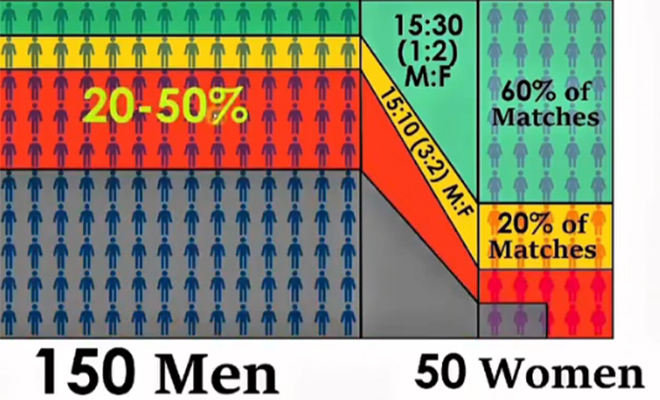
Genealogy leaves receipts. Up to half of male Y-chromosome lines vanished without descendants, while maternal lines kept marching. Wars, accidents, and plain unattractiveness knocked men out of the pool more often than women.
In some eras the effective breeding ratio looked like one man for every two women, or even one for seventeen. Apps did not invent the skew. They made the scoring board public.

What the swipe data shows
Platform samples often look lopsided: about 150 men for every 50 women in a typical slice. Around 60 percent of matches still pile onto the top 10 percent of male profiles. Direct access to that elite tier can warp expectations for everyone else.

Other research sketches the same funnel: the bottom 80 percent of men compete for roughly 22 percent of women, while most women compete for the top fifth of men. Ancient brain software is now running inside a marketplace it never evolved for, and the mismatch is the product.