Beds drying out and the power is off with the well far away? You can still manage without a pump. Archimedes' screw is one of the handiest mechanisms for raising water. Its design is simple: a spiral rotates inside a tube, catching liquid from below and lifting it upward. You can build such a mechanism yourself from an ordinary plastic pipe, flexible hose, and metal rod.

What you will need:
- a plastic pipe 50–100 mm in diameter;
- a flexible hose or plastic strip for the spiral;
- a metal rod or tube for the shaft;
- clamps or wire for fastening;
- two bearings;
- a handle for turning;
- a hacksaw;
- a drill;
- screws or bolts.
For a first attempt it is better to make a small screw about 1–1.5 m long. Such a mechanism is easier to assemble and test. If the model is small, one pipe and a flexible hose may be enough — simply wrap the hose around the core and secure it.
How to make the spiral
Start with a flexible strip or a small-diameter plastic tube. Wrap the material around the central shaft with an even pitch.
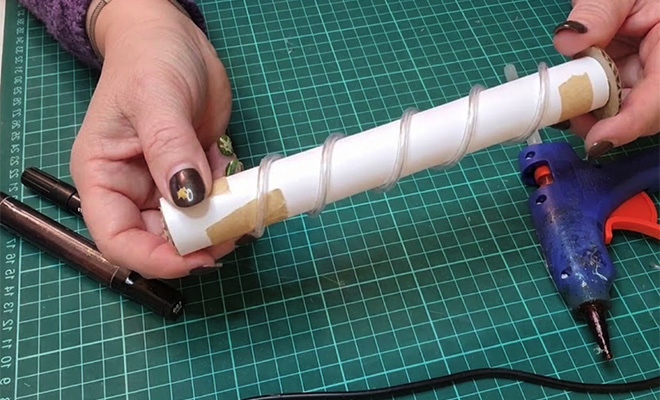
Try to keep the same distance between turns along the full length. The more even the spiral, the more steadily the screw will catch and move water.
Secure each turn to the shaft with a clamp or other reliable fastener. Then check that the spiral does not shift during rotation.
See what such a spiral looks like in video:
How to assemble the housing
- Place the finished spiral inside the plastic pipe. Leave a small gap between the edges of the turns and the inner wall of the housing.
- A gap that is too large reduces efficiency: water will flow back down between the spiral and the wall. A gap that is too small can cause jamming when sand or small debris gets in.
- Mount bearings at both ends of the shaft. Make sure the rod rotates freely inside the pipe.
How to install the screw
- Lower the bottom end of the screw into the water at a slight angle.
- Position the top end above the water level.
- Set the structure at an angle of about 30–45 degrees to the surface. You can adjust the exact angle during testing to find the most effective position.
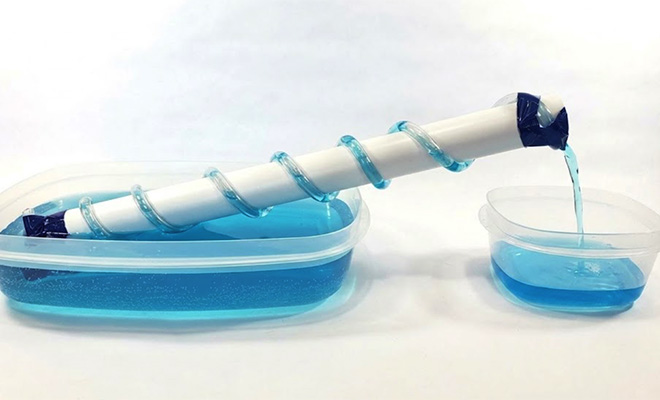
The main requirement is that the lower part of the spiral must reach into the water and the upper part must discharge it into a prepared container or channel.
How to use Archimedes' screw
The simplest option is to fit a handle to the top end of the shaft. Turn the handle several times and check the water flow. As the spiral rotates, it catches water with the lower turns. The water then moves upward along the inner surface of the housing and exits through the top opening.
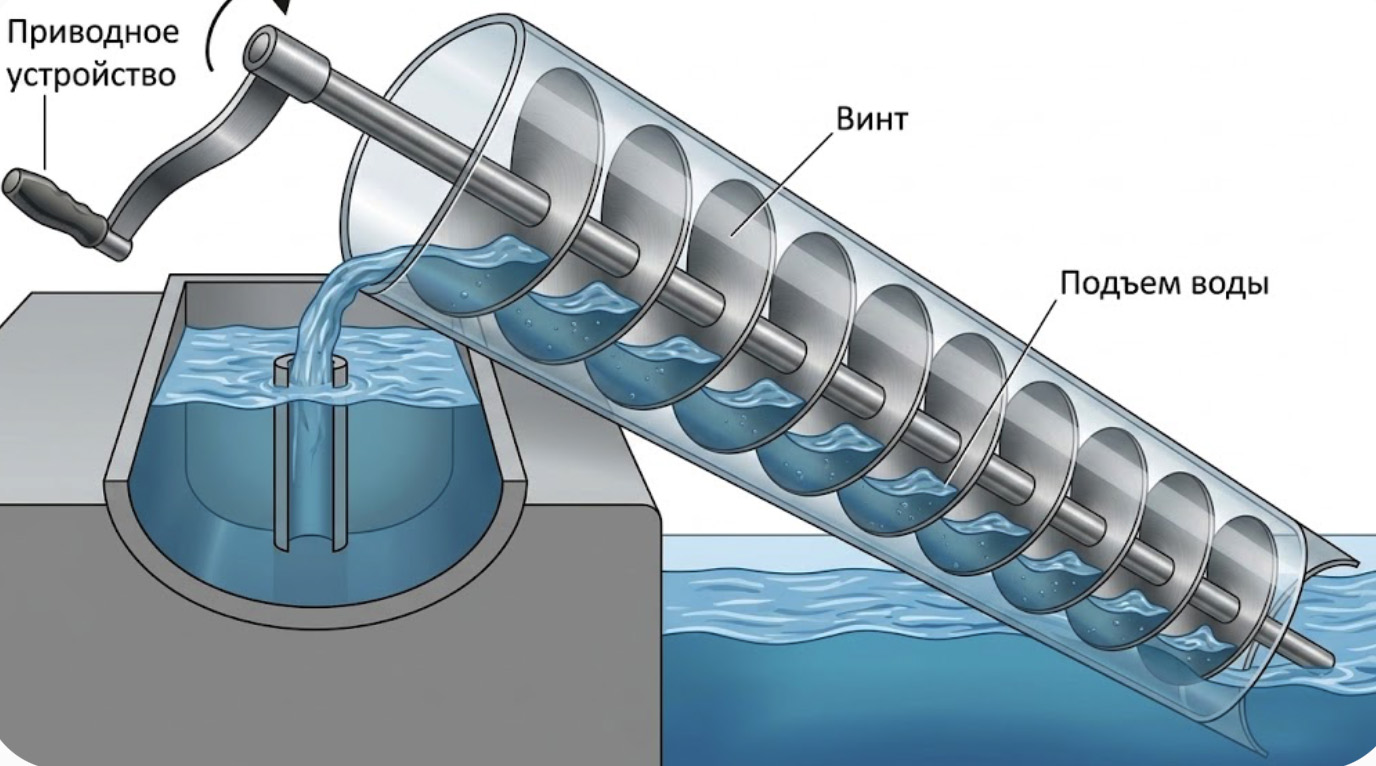
If you need to automate the mechanism, mount an electric motor with a suitable gearbox on the shaft. Use a coupling between the motor and the shaft that can handle the load and will not transfer excessive vibration.
Here is how Archimedes' screw works:
For a homemade build, start with manual drive. That makes it easier to check rotation direction, installation angle, and freedom from jamming.
How to increase output
The screw's output depends on spiral diameter, pitch, rotation speed, tilt angle, and how far the lower section is submerged. Increase the housing and spiral diameter and the screw will move more water per revolution. Reduce an excessively large gap between spiral and housing and less water will flow back down. At the same time, excessively high rotation speed does not always give a better result. Water may start splashing and be held less reliably between the turns. For clean water a plastic build will do. If the water contains sand, silt, or small stones, use stronger materials and leave a slightly larger working gap.
Archimedes' screw works well for lifting water to a modest height at a relatively large flow rate. It is not a replacement for a conventional centrifugal pump in every task.
When building a motorized version, install guards against accidental contact with rotating parts. Keep the electrical components away from water and use equipment with suitable moisture protection.
The principle itself remains extremely simple: a spiral rotates inside a housing, catches water from below, and gradually moves it upward. That is the design that has powered many different mechanisms for centuries.