This frame still lands in roundups of the strangest, most unsettling space images: an astronaut hangs above Earth with no tether, no handhold, and no visible link to the ship, against black sky and a thin blue atmosphere line, while orbiting at about 28,000 km/h. Shot on 7 February 1984 during Space Shuttle Challenger’s mission, it was the first photo of a person free-flying in open space without a safety line.
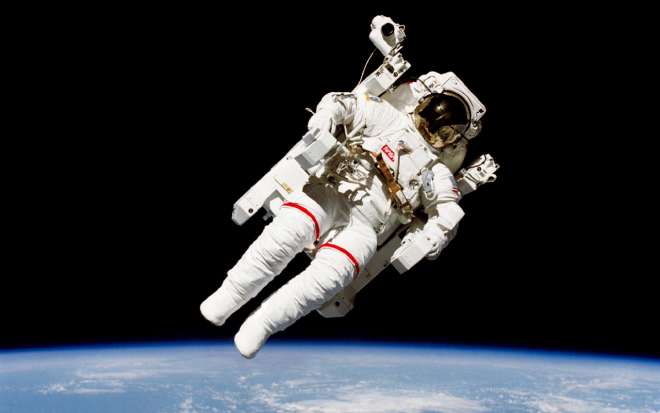
The man is Bruce McCandless II, flying the experimental Manned Maneuvering Unit (MMU), a nitrogen jetpack steered by hand controls in vacuum.
On that EVA he moved about 90 to 100 meters from the shuttle. Tiny on orbital scales, huge for how alone a human looks in the frame.
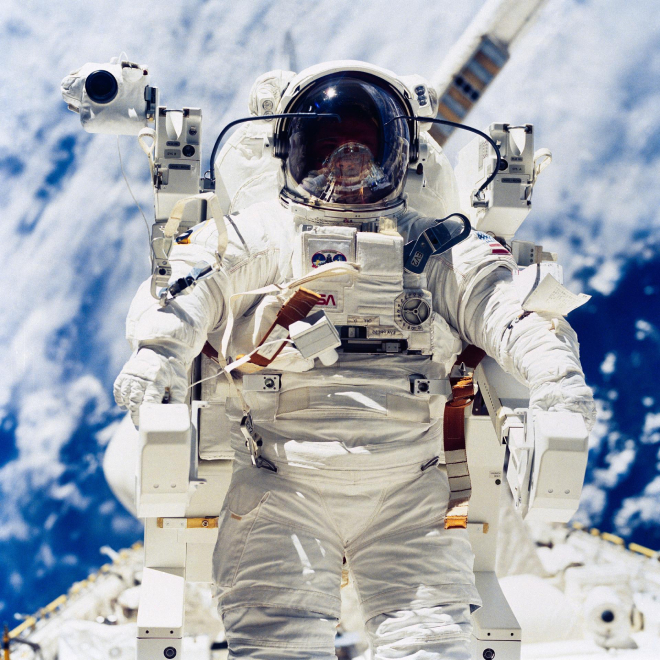
The still looks frozen, yet shuttle and astronaut both raced around Earth at about 7.8 km/s (roughly 28,000 km/h). Relative to the ship his motion stayed slow and deliberate, small thruster taps keeping station. That mix of orbital speed and visual isolation is why the shot still reads as one of space photography’s oddest.
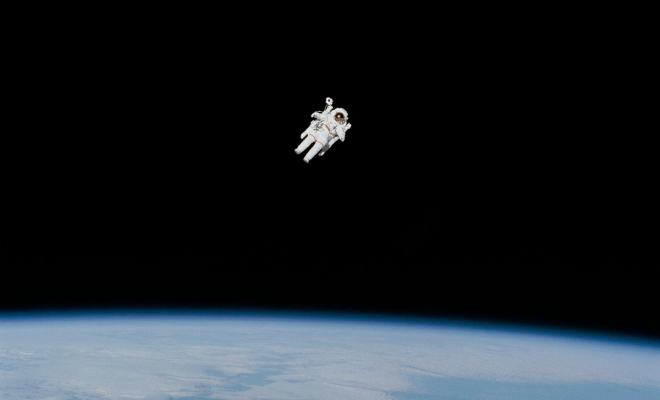
McCandless later put it simply: “I was just a human being flying in space.”
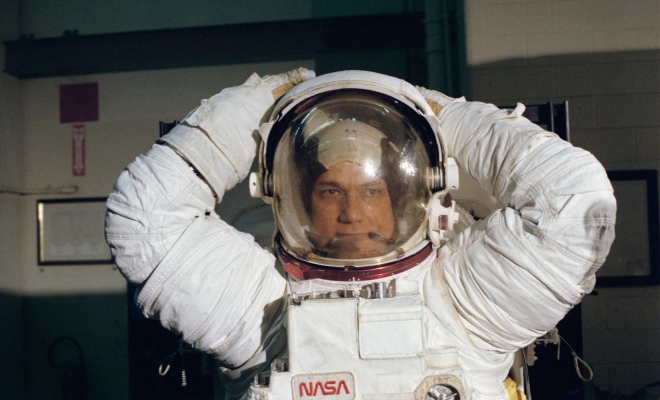
Engineering prep was careful. The MMU went through long tests, including neutral-buoyancy training that mimics microgravity. Risk remained: a serious failure would have left him unable to return alone. It was the first time a spacewalker was not physically tied to the vehicle.
Mission Control treated the EVA as one of the bold early shuttle milestones. The system worked, comms held, and McCandless came back aboard.
Despite the success, the MMU never became routine. It was judged too complex and risky for daily use. Later crews got smaller backups such as SAFER, meant for emergency return to the ship.