In El Salvador’s CECOT mega-prison, cells have no windows, mattresses, or light switches. Lights stay on around the clock for 40,000 people, many sentenced to terms of up to 700 years. Almost everything is banned: press, TV, even talking. The one item the administration allows in a cell is a Bible. Only recently did CECOT let reporters in, and they showed how inmates live here.
How CECOT is built
Inside CECOT, time stands still. Across 256 cells, guards must see every move at every second. There is no room for personal identity. Each cell holds 80 to 156 people sharing multi-tier metal bunks with no mattresses, pillows, or blankets.
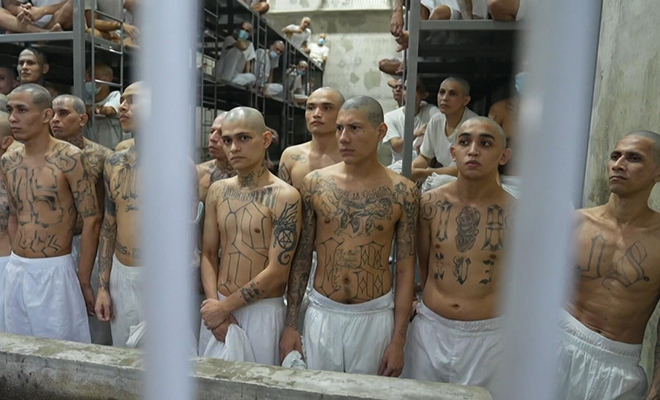
No newspapers, screens, or pencils. Of all culture or leisure items, inmates keep only a Bible. British documentarians from Channel 5, who entered for the project “Richard Madeley on Murder Row,” describe daily life as endless suspended animation. Prisoners spend 23 and a half hours a day locked in, with only thirty minutes of exercise in a closed yard.
Life for a tattoo
Most CECOT residents belong to MS-13 and Barrio 18. Their bodies carry dense criminal ink that here becomes a permanent mark of guilt. Complex director Belarmino Garcia says that in El Salvador such symbols on the skin alone can be enough to keep someone behind bars for the rest of their days.
Sentences of 700 years and more surprise no one. That is just math saying there is no way out. Any breach of the harsh rules means solitary: a sealed concrete bag with no light, for up to thirty days. The diet is harsh too: beans and rice twice a day, no exceptions.
The price of public safety
International human-rights groups raise alarms about clear breaches of humanitarian standards. El Salvador ignores the criticism. President Bukele’s experiment rests on a grim paradox: to stop terror on the streets, the state had to monopolize it inside one perimeter.
In an interview for the documentary, one inmate calmly said he had committed more than a hundred crimes, felt no remorse, and would do it again if free.
The raw brutality of local crime remains El Salvador’s main justification for CECOT.