Today the Sahara is associated with sand dunes, rocky plateaus, and almost no water at all. But about 8,000 years ago, much of what is now desert was green: grasses and trees grew here, rivers flowed, large lakes existed, and people fished, hunted, and herded livestock. What happened to all that water — and why did a green landscape turn into one of the world's largest deserts over a few thousand years?
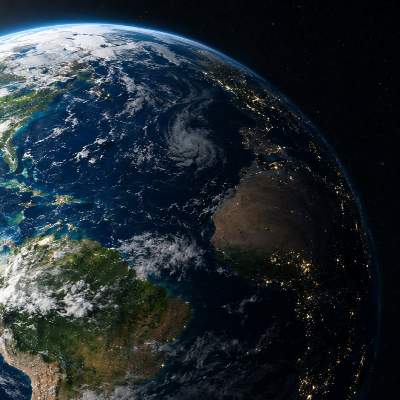
Scientists call this period the African Humid Period. It began roughly 14,500 years ago and lasted several millennia. During that time the African summer monsoon reached much farther north than it does today, bringing far more moisture to North Africa.
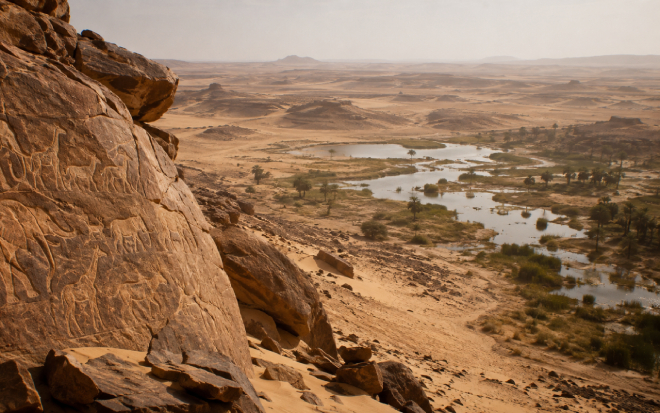
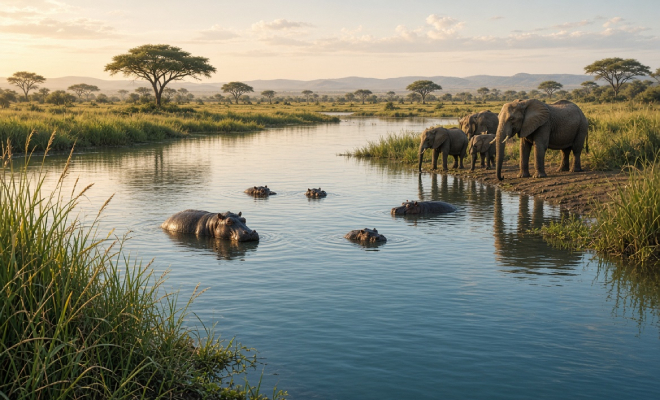
So the Sahara was not one enormous green plain, as illustrations sometimes suggest. Different regions had savannas, grasslands, sparse woodlands, marshes, and lakes. There was especially abundant water where today only traces remain in the soil.
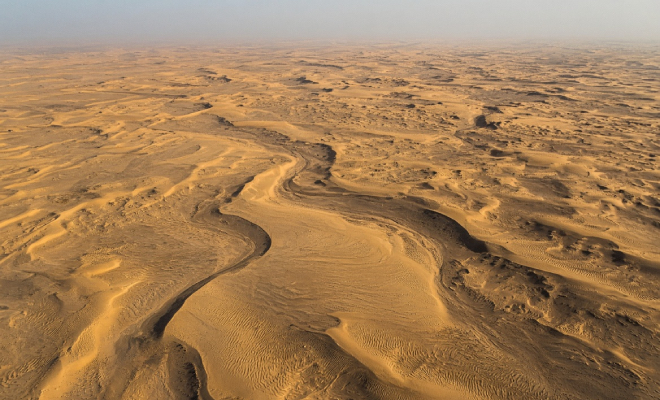
Ancient riverbeds are found even in areas that are desert today. From satellite images and geological data, scientists reconstruct the courses of rivers that existed thousands of years ago. In sediment layers from former lakes, pollen, mollusk shells, and fish remains are preserved. All of this allows researchers to reconstruct in considerable detail a world that vanished from the surface long ago.
Wildlife matched the landscape. Rock art across the Sahara shows elephants, giraffes, antelope, cattle, and hippos. Hippos are especially telling: an animal that spends most of its time in water would have nowhere to live in the modern Sahara.
People settled near the water too. Archaeologists find campsites, stone tools, pottery, and bones of fish and other animals. At first, residents mainly hunted, gathered plants, and fished; later they began raising cattle. Some sites were used for millennia, as long as conditions allowed people to live there.
But about 5,500 years ago, the familiar world began to change. Gradual shifts in Earth's motion reduced summer warming in the Northern Hemisphere, the African monsoon weakened, and the rain belt moved south. Lakes shrank, rivers dried up, vegetation retreated. The Sahara did not dry out in a single year: water left different regions at different speeds, until the green landscape gradually gave way to desert.
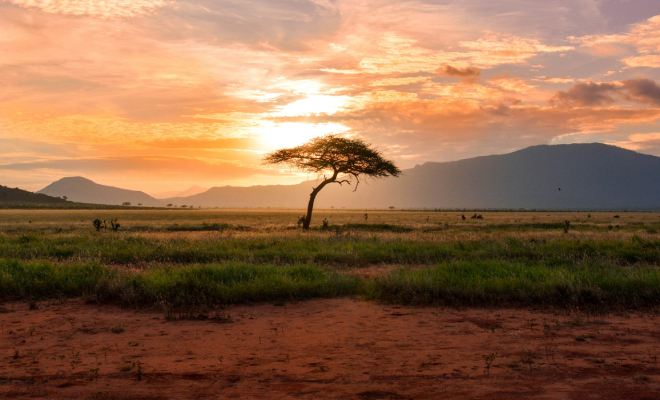
People had to adapt. Some moved where water remained; others shifted to more mobile pastoralism. Population gradually concentrated around the Nile and other reliable water sources. Land that had once supported life thanks to lakes, rivers, and pasture became less and less suitable for permanent settlement.
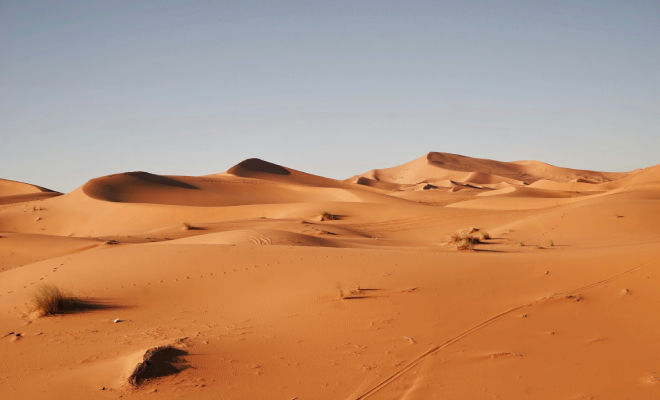
That is how the Sahara acquired the face we know. But its past did not disappear. Ancient riverbeds and lake sediments remain under the sand, and rock walls still carry images of animals and scenes from human life.
There is a curious paradox: the Sahara feels like an eternal desert, yet its current appearance is much younger than many traces of life found beneath the sand. A few thousand years ago this was a different world — with water, greenery, animals, and people. Then the water left, leaving behind one of the planet's largest deserts.