Daniel Defoe did not invent Robinson Crusoe's story. The writer based his novel on the life of a real Scottish sailor, Alexander Selkirk, known for his hot temper. He really did spend four years on an uninhabited island that is still marked on maps in the Pacific today.
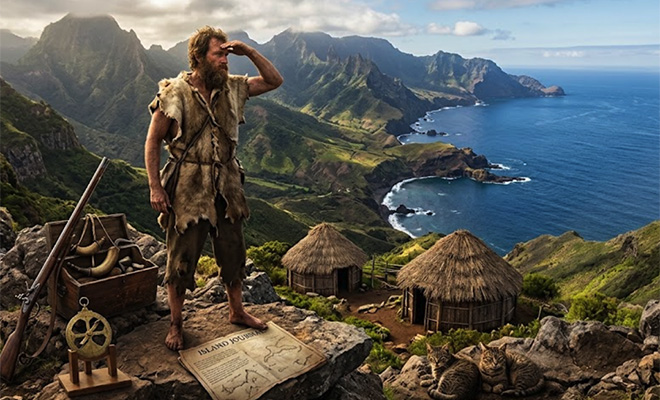
How Selkirk ended up on an uninhabited island
Unlike the book's hero, Selkirk did not reach the island through a shipwreck but through a scandal. The sailor served on the English privateer Cinque Ports, which was operating off the coast of South America. The Scot considered the ship unseaworthy and demanded to be put ashore.
Selkirk turned out to be right: the vessel soon sank. But that was little comfort to a sailor left in the middle of the ocean with a musket, gunpowder, a chest of tools, and an astrolabe.
The first months were a severe trial for Selkirk. He did not know how long he would have to stay on the island. He had to adapt: the former sailor learned to find food, hunt, and use the island's natural resources.
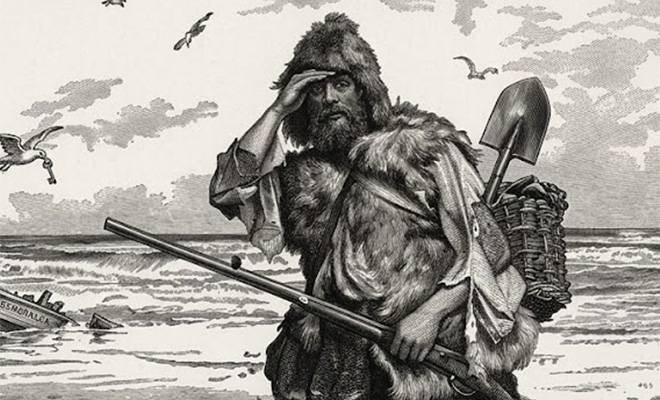
- Food: Wild goats (introduced earlier by the Spanish), crayfish, shellfish, and wild pepper. When the gunpowder ran out, Selkirk learned to catch goats barefoot.
- Shelter and clothing: He built two huts from pepper mint trees. From goatskins, using a nail in place of a needle, he sewed himself a coat and a hat.
- Protection from rats: To escape swarms of rats at night, Selkirk tamed feral cats once brought by pirates.
He also grew vegetables and used available plants. To protect himself from bad weather, Selkirk fitted out a dwelling and gradually turned an accidental landing site into a livable refuge.
How the sailor was rescued
In February 1709 an English ship, the Duke, anchored at the island. The crew barely recognized the wild-looking man in goatskins as their countryman: Selkirk had almost forgotten how to speak and retold his story with great difficulty.
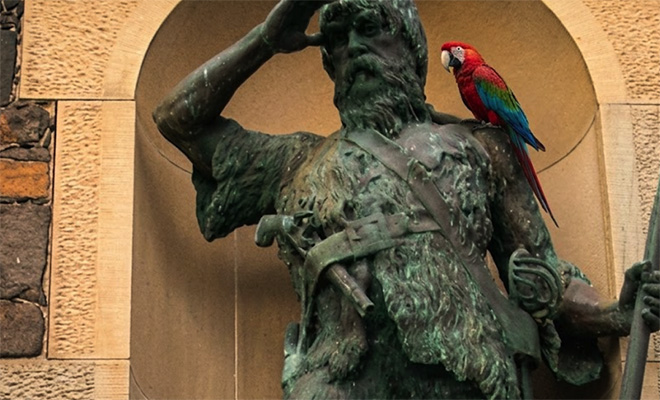
Back in Britain he became a national celebrity. His memoirs inspired Daniel Defoe to write the novel in 1719. For dramatic effect Defoe changed the setting (moving the action to the Atlantic), extended the hero's stay from 4 to 28 years, and added the Friday storyline.
Where Robinson Crusoe lived
The place where Selkirk spent four years and four months in absolute solitude still exists today. It is Mas-a-Tierra Island, part of the volcanic Juan Fernandez archipelago 670 kilometers off the coast of Chile.
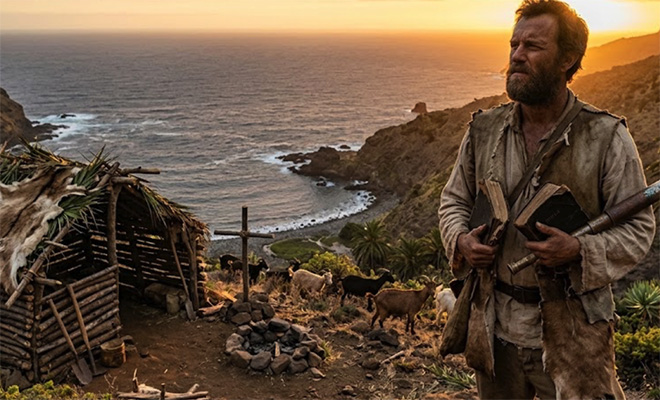
In 1966 the Chilean government officially renamed this piece of land Robinson Crusoe Island (Isla Róbinson Crusoe) to attract tourists and immortalize the literary legend.
The island is nothing like the small patch of land from the adventure novel. It has mountains, deep valleys, forests, and a coastline with many bays. Its nature remains quite wild.
A small settlement, San Juan Bautista, exists on the island. Local residents have historically made their living from fishing and harvesting seafood. A monument to Selkirk stands on the island, and a tourist route marks his story.
More than three centuries have passed, but the place of his forced solitude has not disappeared. Today anyone can travel to where the Scottish sailor spent more than four years, scanning the horizon every day in search of rescue.