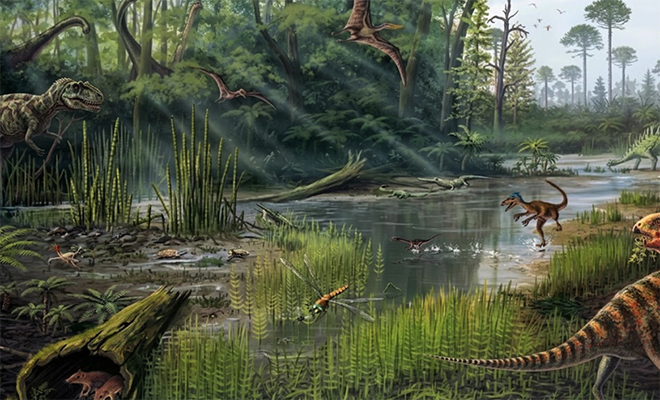
The forest of dinosaur times was not filled with heavy footsteps of large animals and loud roars. The night soundscape of Jurassic woodland turned out to be far more complex — scientists have only recently managed to reconstruct part of this ancient “chorus” and record what the forest sounded like 165 million years ago.

Entomologists helped reconstruct the ancient sounds. In crickets, grasshoppers, and their ancient relatives, sound production is tied to hard wing structures that can survive fossilization. Researchers studied 20 fossil specimens from nine species, then combined wing-structure data with experiments on modern insects, computer modeling, and machine learning.
On the forewing of some of these insects there is a kind of “file” — a row of small teeth. When another part of the wing passes over it, vibrations arise and the wing begins to work like a sound generator. Size, shape, and spacing of the teeth allow researchers to approximate the frequency of sound the insect produced.
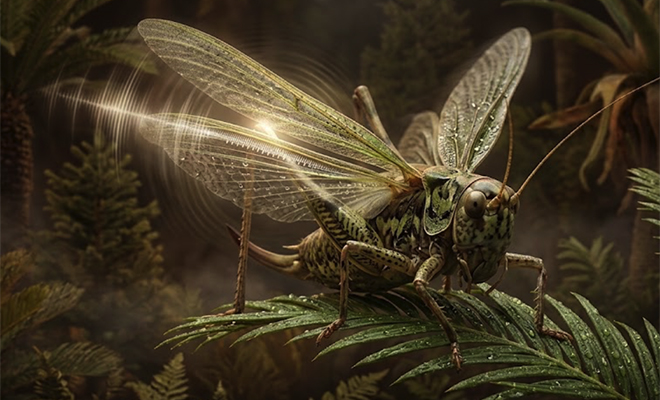
To test their calculations, scientists first worked with modern crickets and grasshoppers. Researchers measured wing vibrations with lasers and compared the results with computer models. They then applied the same approach to fossilized wings of ancient insects.

Most of the species studied, according to the calculations, produced relatively low sounds for such insects. Their frequency could be around 5 kHz — comparable to some modern crickets.
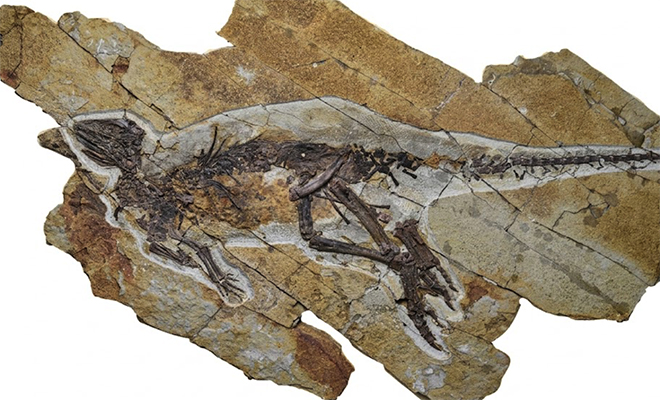
But one species stood out. Sigmaboilus peregrinus, a relative of modern grasshoppers, could have produced sound in a range of roughly 20 to 22 kHz. That is at the edge of human hearing and above it: sounds above 20 kHz are considered ultrasound.
Scientists have long linked the spread of ultrasonic communication in insects to the appearance of bats. These mammals use high-frequency signals for echolocation, so it was thought insects might have had to shift their signal frequency in response to a new predator. Yet the first bats appeared roughly 100 million years after the Jurassic period. If the Sigmaboilus peregrinus reconstruction is correct, insects were already using ultrasonic signals long before this class of predators existed.
The study authors suggest pressure may have come from early mammals and other animals capable of hearing and locating insects by sound. Over time a kind of acoustic arms race may have developed between predators and prey: insects changed signal frequency, and their hearing adapted to new conditions.
Ancient Insects May Have Sounded Like Electronic Signals
The reconstructed sounds differ from the familiar modern buzz or sharp chirp of some insects. Many were fairly pure, narrow-band tones — most of the energy concentrated in a small frequency range. To human ears, the accessible sounds might resemble short high whistles or electronic signals repeating in bursts. Part of the ancient “chorus” would be inaudible to humans because the frequency was too high.
Wing anatomy allows highly accurate determination of physical frequency and pitch, but it does not preserve nerve impulses. Song speed and rhythmic pattern are controlled by the nervous system, so scientists could only estimate potential chirping tempo with the help of AI.