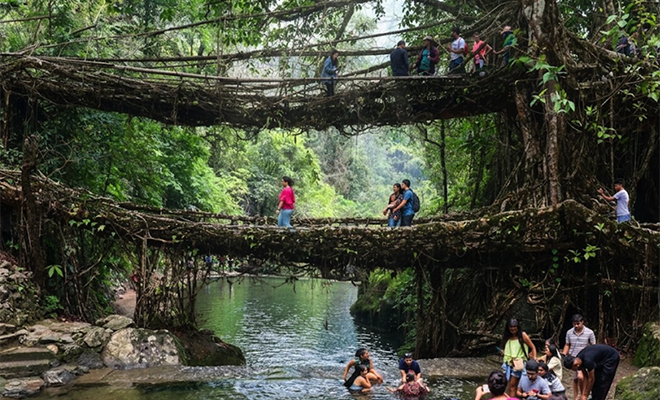
In the mountainous Indian state of Meghalaya, wooden bridges rot quickly, floods destroy concrete structures, and steel cannot withstand constant damp. The region’s indigenous Khasi and Jaintia peoples solved the problem in a unique way: they do not build bridges — they grow them from living trees.
How a Bridge Made of Tree Works
Living bridges are built from the roots of the rubber fig (Ficus elastica). Local residents guide their growth across mountain rivers using bamboo frames or split palm trunks.
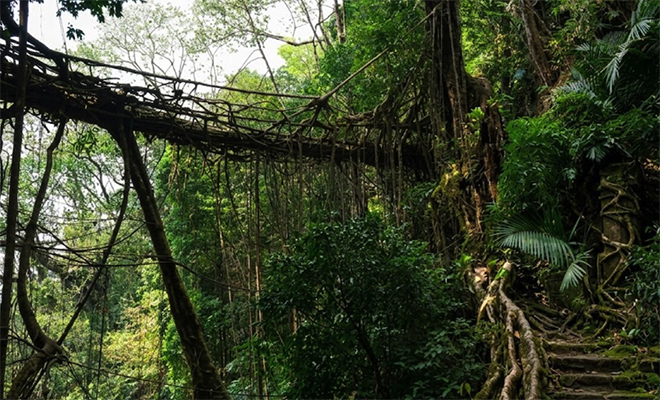
Over time the flexible roots reach the opposite bank, take hold in the soil, intertwine, and form a strong, physically stable structure.
- Service life: Building such a bridge takes 15 to 30 years, but it lasts not one decade — several centuries.
- Scale: Individual living bridges stretch more than 50 meters and easily support the weight of dozens of people at once.
Why Roots Outlast Concrete and Steel
The main secret of living bridges is their ability to grow stronger over time. Unlike concrete, which cracks with age, and iron, which rusts, ficus roots keep growing, thickening, and fusing together (anastomosis). The older the bridge, the more reliable it becomes.
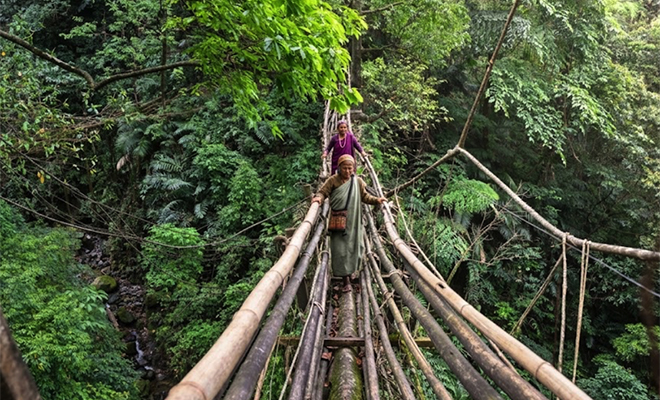
Moreover, a living tree’s root system stabilizes riverbanks and helps prevent landslides during storms.
3D Models and Mapping
Masters passed down the technique of making living bridges only within their own craft. The process was documented in detail by a team led by Professor Ferdinand Ludwig of the Technical University of Munich (TUM) and Professor Thomas Speck of the University of Freiburg.
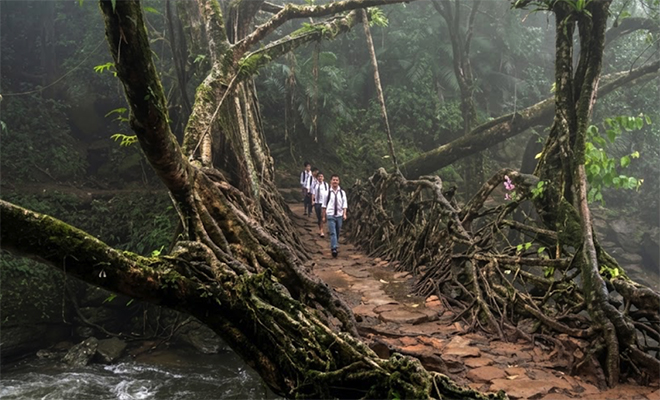
Researchers studied and mapped 74 living bridges in remote parts of Meghalaya for the first time. The team took thousands of high-precision photographs and used them to build three-dimensional models of complex root systems. Scientists also recorded oral instructions from local builders to preserve traditional weaving methods and root-guiding techniques.
Lessons for the Architecture of the Future
Research on living bridges has become a foundation for developing baubotanics — building with living plants — in modern architecture.
Scientists believe the experience of India’s tribal communities can help create eco-friendly, self-repairing engineering structures in modern cities as well. Integrating living trees into urban environments can reduce carbon dioxide levels, protect streets from overheating, and create durable infrastructure without buying concrete and metal.