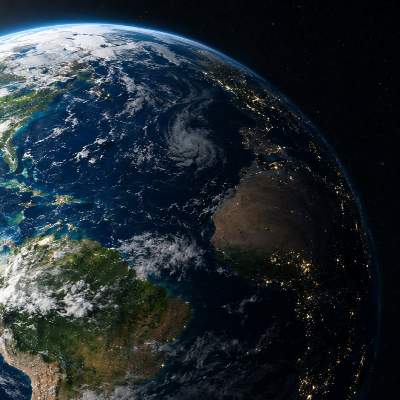
We're used to 24 hours in a day, but Earth has never spun at a constant speed. About 1.4 billion years ago, a full rotation took roughly 19 hours. Since then, days have grown longer — though sometimes Earth spins a little faster instead.
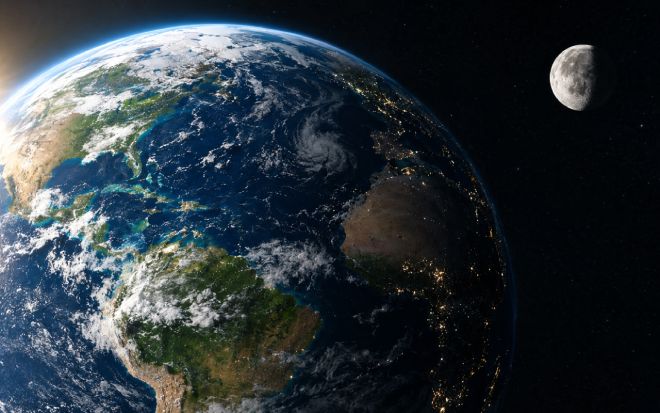
Earth Used to Spin Faster
Today Earth completes one rotation in about 24 hours. But it wasn't always that way. Calculations based on geological data show that days were significantly shorter in the past.
Scientists reconstruct day length from tidal traces and other cyclical changes preserved in rock. A 2023 study painted a particularly striking picture: for roughly a billion years, the length of a day may have stayed around 19 hours.
The 19-Hour Puzzle
This is where it gets interesting. If the Moon is gradually slowing Earth's rotation, days should keep getting longer. But calculations show that over a vast stretch of time, that barely happened.
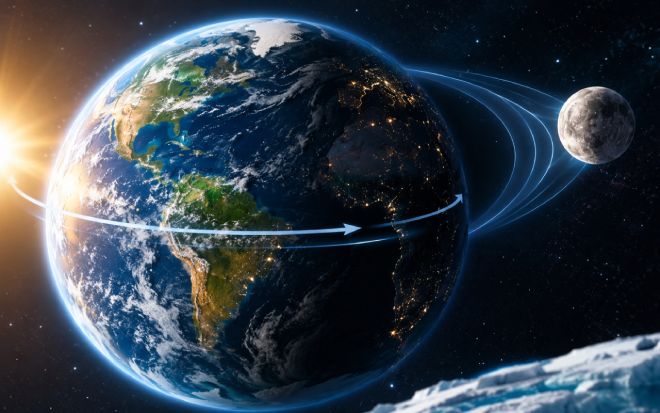
Researchers suggest Earth entered a kind of balance. The Moon slowed the planet through tides, while heating of the atmosphere by the Sun created a counter-tide that pushed in the opposite direction. For a certain period, the two effects may have nearly cancelled each other out.

Days seemed to get "stuck" at around 19 hours. The Moon kept affecting Earth, but its braking action was temporarily offset by the atmospheric effect linked to the Sun. Researchers used this idea to explain the unusually long period of nearly unchanged day length.
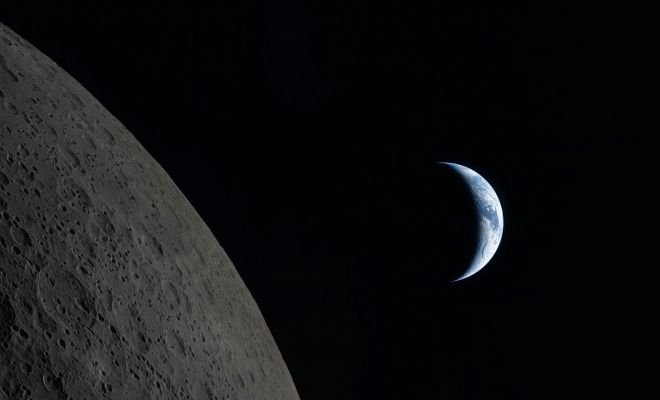
That doesn't mean scientists know the exact length of every day from that era. Estimates are based on surviving data and carry a margin of error. But the idea that day length plateaued at about 19 hours gained support from analysis of several independent datasets.
The Moon Slows Earth Down
Under normal conditions, the Moon really does gradually slow our planet's rotation.
It pulls on the oceans, creating tides. Because Earth is spinning, the water doesn't move in perfect sync with the Moon's position. Friction arises, and some of Earth's rotational energy is gradually transferred to the Earth–Moon system.
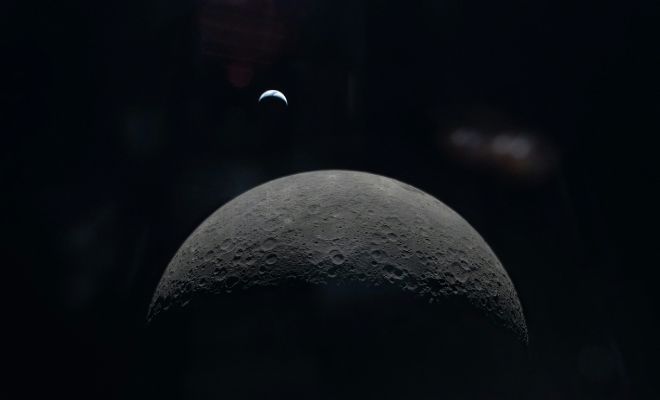
Earth slowly loses speed, while the Moon drifts away from it by about 3.8 cm per year.
You can't notice this in a human lifetime. But over hundreds of millions of years, the difference becomes enormous. That's why the average length of a day keeps growing.
Sometimes Earth Speeds Up
Yet the process doesn't run in one direction only. Earth's rotation speed constantly shifts slightly. The atmosphere, oceans, movement of matter inside the planet, earthquakes, and redistribution of mass all play a role.
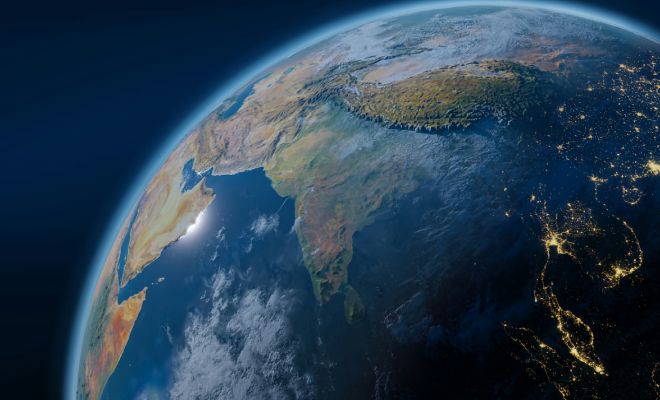
Because of this, individual days can end up slightly shorter than the usual 24 hours. On June 29, 2022, for example, the day was about 1.59 milliseconds shorter than the standard 86,400 seconds. The difference is invisible to us, but ultra-precise clocks and timekeeping systems record it.
Melting Ice Also Changes Rotation Speed
Even where water sits on the planet affects how Earth spins. When ice in Greenland and Antarctica melts, water shifts from the poles toward lower latitudes. Earth's mass is distributed a little differently, and the planet's rotation slows.
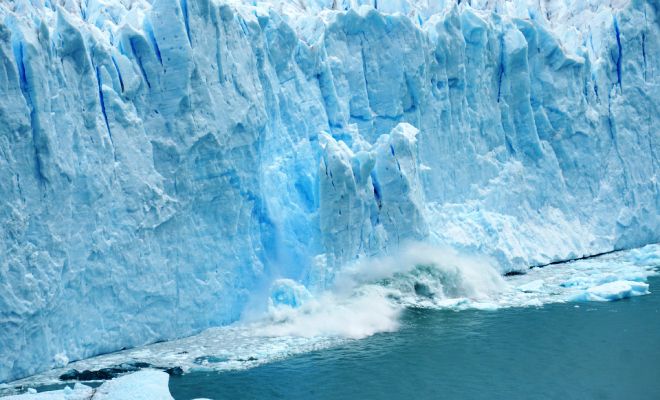
The effect is tiny, but measurable. A 2024 study showed that polar ice melt really does influence Earth's rotation speed. According to researchers, this process is already noticeably affecting how astronomical and atomic time are kept in sync.
So Earth's rotation speed is shaped at once by the Moon, the atmosphere, the oceans, movement of matter inside the planet, and even melting ice.
24 Hours Won't Last Forever
24-hour days aren't some fixed constant. They're simply how long a day lasts in our era.
Billions of years ago Earth spun faster and days were shorter. Going forward, the Moon will keep gradually slowing the planet, so on average days will grow longer.
But over shorter timescales, things can work differently. Earth speeds up a little, then slows again, and day length shifts by fractions of a millisecond.
These changes are practically invisible in daily life. But the story of 19-hour days shows how much Earth's familiar rhythm can shift over billions of years.