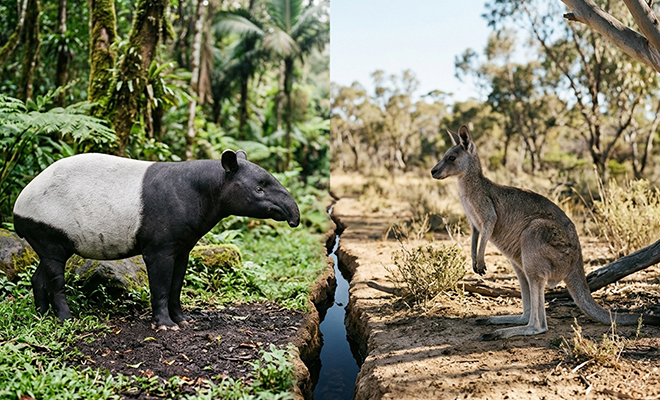
Stand on Bali's eastern shore on a clear day and look across the sea — and you can easily spot neighboring Lombok. The gap is just 35 kilometers; a boat crosses it in under an hour. For animals, though, that tiny stretch became an impassable wall. That invisible boundary is called the Wallace Line.
An Invisible Line Between Two Continents
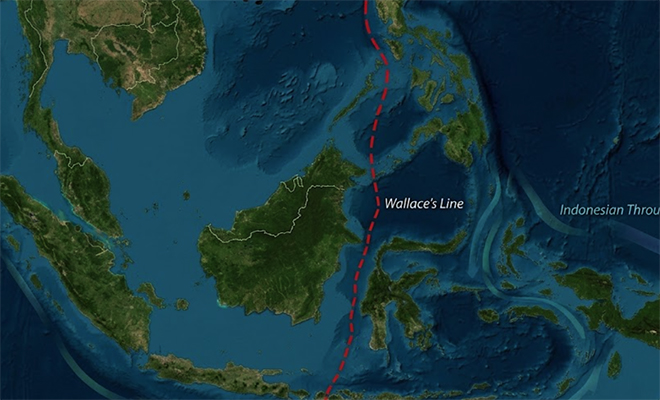
British naturalist Alfred Wallace noticed this oddity back in the nineteenth century. The Malay Archipelago, he saw, is cut as if by a knife into two utterly different zones. West of the Wallace Line — on Sumatra, Java, Borneo, and Bali — Asian species dominate. East of it — on Lombok, Sulawesi, and on toward New Guinea — an entirely different world begins, kin to Australia's.
So why haven't animals that can swim or fly crossed that symbolic gap between the islands over millions of years?
Why Animals Don't Cross the Wallace Line
The main reason animals don't cross the Wallace Line isn't the width of the strait — it's geology, the history of ice ages, and the power of ocean currents.
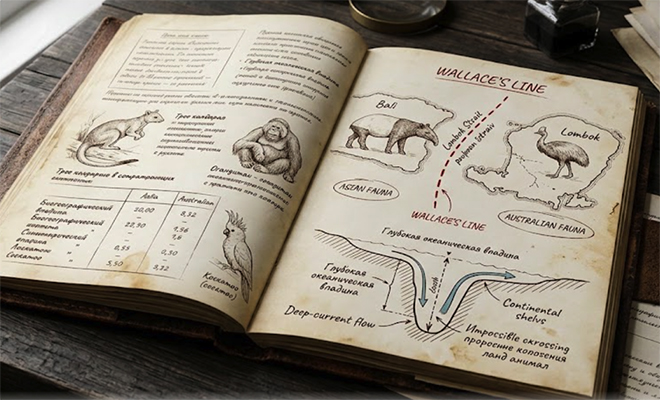
During glacial periods, global sea level fell by more than 120 meters. Sumatra, Java, Kalimantan, and Bali then joined the Asian mainland as one landmass — the Sunda Shelf.
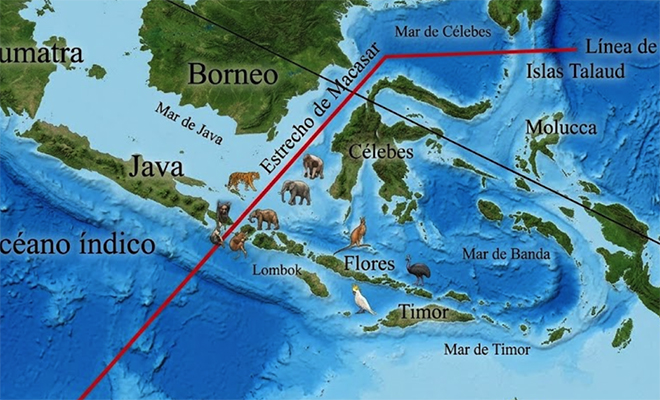
Asian animals spread freely across that dry land all the way to Bali. Similarly, Australia and New Guinea merged into the continent of Sahul. But the straits between Bali and Lombok, and between Borneo and Sulawesi, are ultra-deep tectonic trenches — hundreds to thousands of meters down. They never dried out even at the peak of the ice age, leaving an impassable water barrier between the continental shelves.
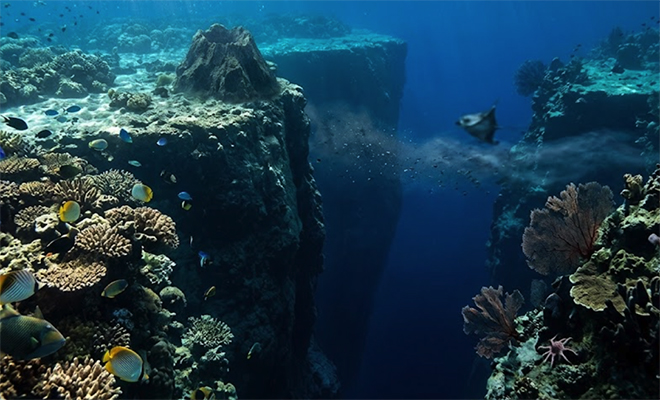
There's more. The Lombok and Makassar straits lie on the Indonesian Throughflow — a giant ocean current that pumps enormous volumes of water from the Pacific into the Indian Ocean. Land animals can't fight it.
Which raises another question: why don't birds cross the Wallace Line? Many tropical forest birds — Asian barbets on one side, Australian cockatoos on the other — evolved for life under a dense canopy. Open water with no familiar landmarks is a stressful barrier; they avoid flying over the straits.
Because of deep water and fierce currents together, Asian and Australian animals evolved independently for tens of millions of years. On one side of the strait, evolution produced large placental predators and mammals; on the other, it preserved an ancient, fragile world of marsupials.