About a kilometer down in the absolute dark of the Pacific, the deep-diving Hercules vehicle once lit up neat yellow plates. They lay so tidy and square that researchers aboard E/V Nautilus joked about the road to the Emerald City and a sunken Atlantis. The find on the Liliuokalani Ridge near Hawaii was quickly nicknamed the “yellow brick road.”
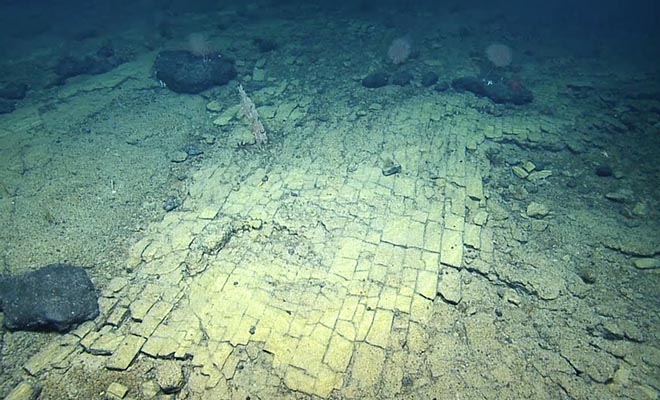
A frame on the Liliuokalani Ridge
The science cruise worked in the Papahanaumokuakea Marine National Monument. The E/V Nautilus crew’s job was standard: collect rock samples from ancient drowned mountains and build a 3D map of the seafloor. In a live stream, ROV operators saw a strange rock bed cut into rectangular blocks with clean 90-degree corners.
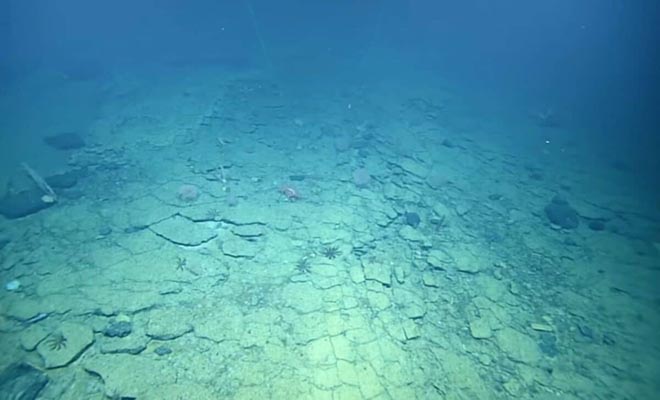
The surface looked like hand-laid paving running up the ridge slope. The yellowish-brown rock stood out sharply against the usual dark basalt, which only strengthened the sense that someone had built it.
Physics instead of Atlantis
Geologists quickly cleared up the “pavement.” The mysterious plates were hyaloclastite, a volcanic rock that forms in deep eruptions. When hot lava hits the seafloor, it cools at once against ice-cold water under about a hundred atmospheres of pressure.
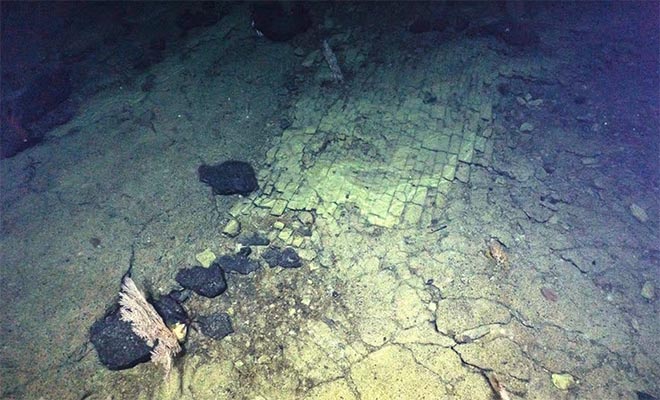
A dense crust forms on the lava flow. Later eruptions and constant temperature swings from hydrothermal vents put uneven stress on that crust. The lava expanded and contracted, then cracked at right angles. The process is like clay drying and cracking on a dried lake bed: physics breaks a uniform material along clean geometric lines.
Why scientists care about underwater “paving”
Papahanaumokuakea covers more than 1.5 million square kilometers, and most of it is still a blank on maps. The seamounts there formed millions of years ago when the Hawaiian hotspot burned through oceanic crust.
The “yellow brick road” on the Liliuokalani Ridge helped researchers see more clearly how ancient underwater eruptions unfolded. Ideal cracks in hyaloclastite are markers of hydrothermal activity.