Talk of a hypothetical Planet Nine, also called Planet X, has gone on for years. Orbits of a whole group of distant icy asteroids are stretched and tilted as if held by the gravity of some massive body. In September 2026 astronomer Terry Long Fan got the first potential evidence that another planet may really sit in the Solar System.
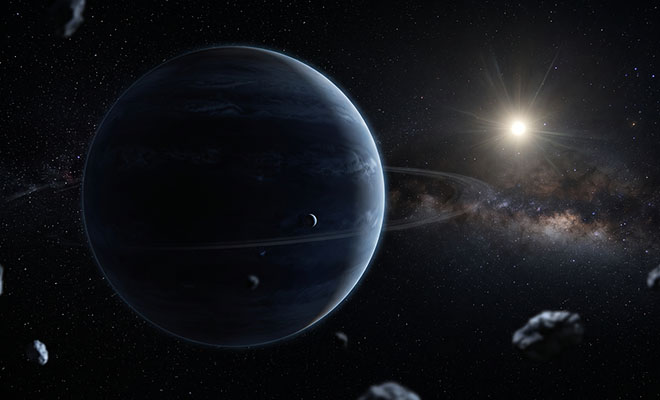
Why Planet Nine has been so hard to find
It comes down to simple optics. To see an object that far away in a normal telescope, sunlight must reach the planet, bounce off it, and travel back to Earth. If the object sits ten times farther than Neptune, it looks 10,000 times fainter to a terrestrial observer.
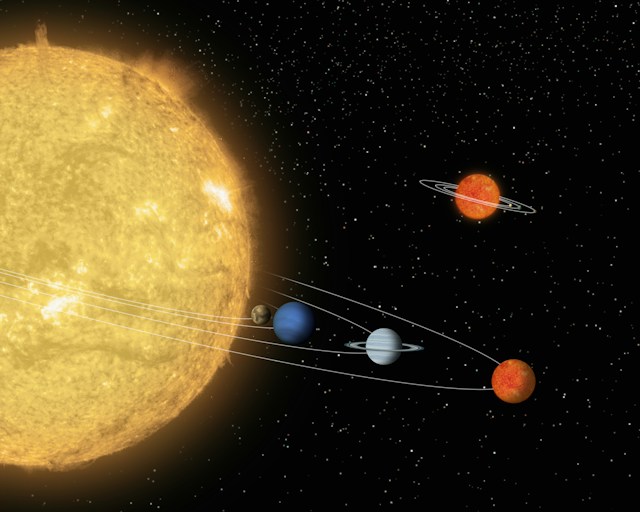
The planet’s own heat radiation makes only one trip: from the object to Earth. In infrared a potential Planet Nine looks only about 100 times fainter than Neptune, so the search belongs on infrared telescopes.
How the evidence turned up
Fan and colleagues compared data from two all-sky infrared space surveys.
- IRAS: a U.S. infrared telescope launched in 1983.
- AKARI: a Japanese spacecraft that flew in 2006.
At that distance from the Sun, Planet Nine would crawl along its orbit. On each survey alone it would look like a fixed point. Over the 23 years between IRAS and AKARI the object should have shifted on the sky; that difference is what revealed it.
Only one candidate left
Special software sifted infrared sources and picked pairs that moved over 23 years by a distance that fits an object at the Solar System’s edge. It returned 13 candidates.
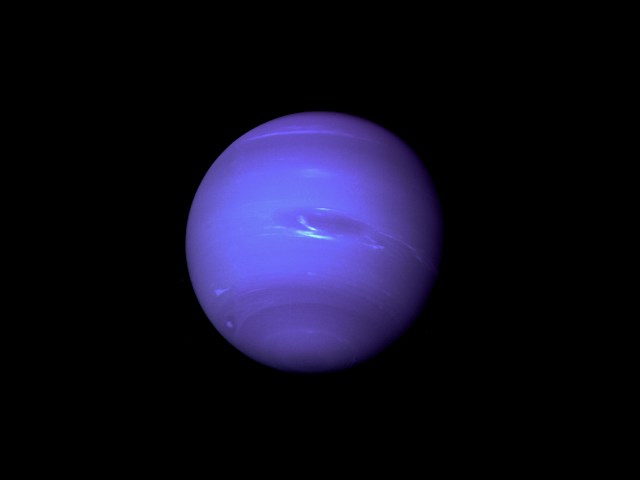
After hand checks and discarding false signals, one pair remained.
The infrared source moved 47.5 arcminutes over 23 years. That is about one and a half times the apparent diameter of the full Moon.
The signal’s traits match what a Neptune-size ice giant should look like on the far fringe of our system.
Two sky detections are still not enough to pin down the orbit and confirm the find with certainty. Astronomers are preparing follow-up observations.