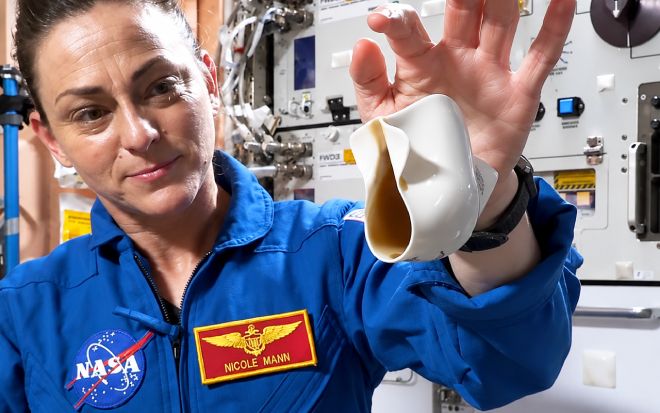
In weightlessness water wants to leave any open vessel. In the Space Cup it does not simply stay put: it moves toward the rim, toward the spot where you drink. Donald Pettit’s invention does not fight physics. It makes the laws work for you.
How an ordinary coffee mug reached orbit
Before the Space Cup, astronauts mostly drank from sealed pouches with straws. It worked, but even morning coffee felt like sucking a package.
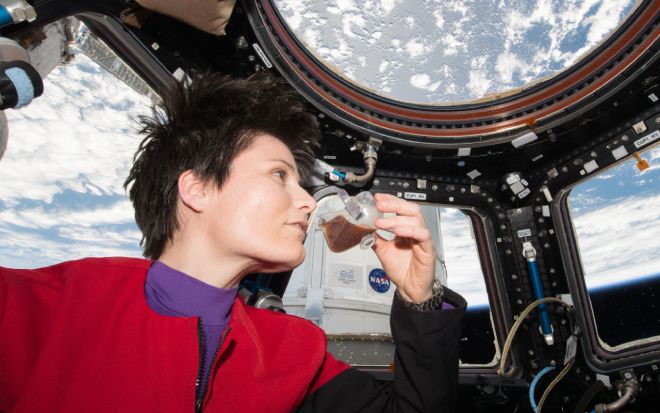
Pettit wanted a normal mug in space. He was not only an astronaut but an engineer who liked experimenting with liquids in microgravity.
In November 2008, on shuttle Endeavour’s STS-126 mission to the ISS, he built a first prototype from what was on hand: thin plastic film and heat-resistant tape. The shape was a droplet with a pointed edge.
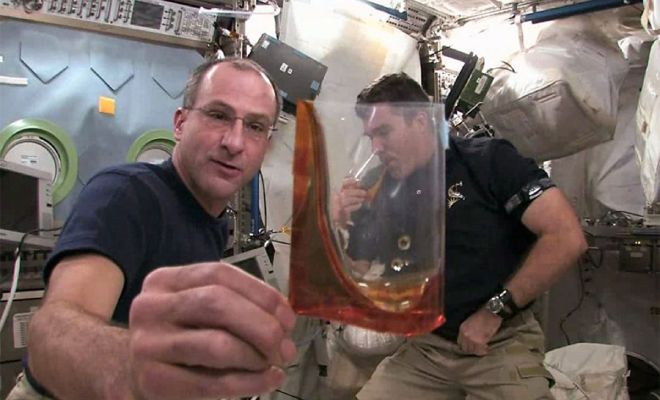
The idea was to use forces that barely show on Earth because gravity swamps them. In space those same forces can steer a liquid.
The experiment looked promising enough that fluid physicists joined in, including Mark Weislogel of Oregon State University. The homemade film-and-tape cup became a cleaner model that could be 3D-printed.
In 2012 an improved mug was successfully tested in space. One astronaut’s experiment became a full engineering project.
Why water does not pour from an ordinary mug in space
To see how the Space Cup works, first see what water does when “down” disappears.
On Earth gravity constantly pulls water toward the floor. Tilt a mug and the liquid surface stays horizontal while the drink spills over the rim.
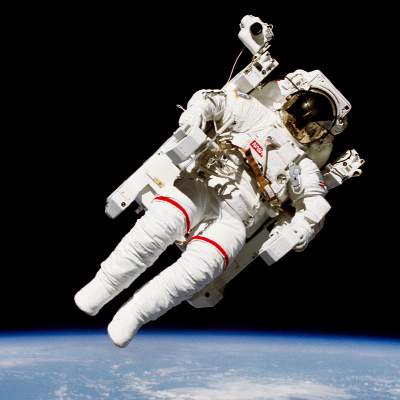
On orbit everything is different. The station and everything inside it are continuously falling around Earth. That is microgravity: gravity is still there, but its familiar effect on liquids is barely felt.
Pour water into an ordinary open mug in space and it will not necessarily spill out. Instead it forms rounded blobs and sticks to surfaces. It will not sit calmly on the bottom like coffee on a kitchen table.
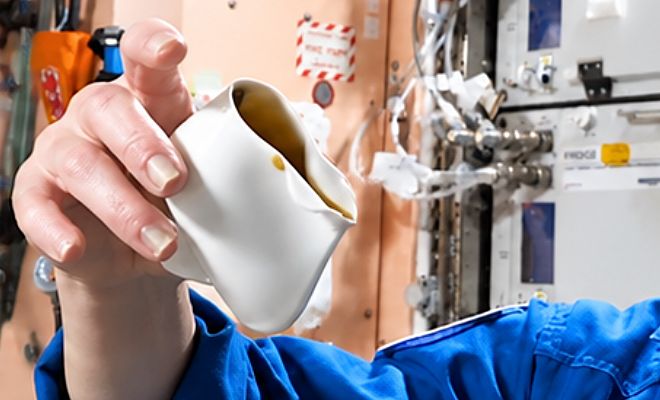
Now imagine tilting that mug. On Earth water runs to the low edge. In weightlessness it may stay on the wall, form a sphere, or drift to the rim simply because you turned the cup.
Nothing steers the liquid where you need it. A normal mug cannot manage water in those conditions. If a drop leaves the surface it does not fall to the floor; it floats through the cabin.
A free-floating drop can hit electronics, enter a vent, or land on gear never meant to get wet.
How the Space Cup works: physics instead of gravity
The design uses three effects: surface tension, wetting, and capillarity.
Start with surface tension. Water molecules attract each other, so the liquid surface acts like a thin elastic film. That is why a small drop keeps a compact shape instead of spreading forever.
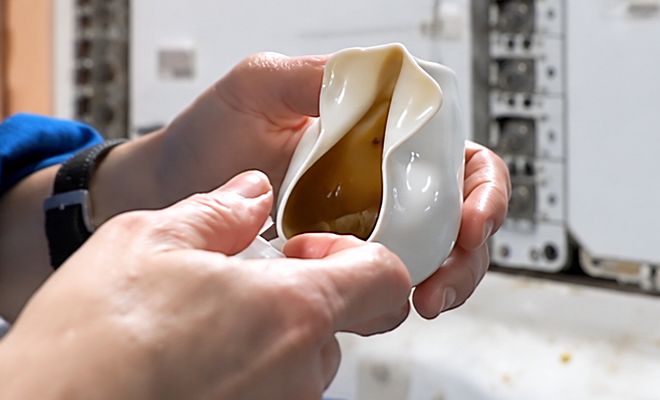
Next is wetting. Water interacts with the mug walls. Depending on material and shape it may cling well or barely stick.
You can tune that. With the right material and geometry, water moves along the wall in a chosen direction.
Third is the capillary effect. Paper towel soaks up a spill; water climbs a thin tube. In a narrow channel, surface tension and wall interaction can move liquid even against gravity.
What happens inside the cup
The Space Cup uses water’s behavior on purpose.
- You pour the drink. In microgravity the liquid sticks to surfaces and starts moving through the channel.
- Water rises to the rim. Channel shape and surface tension guide it to the edge.
- Liquid holds at the edge. Forces reach balance, so the drink does not spill on its own.
- You take a sip. Lips touch the rim and draw liquid from the channel. Balance breaks, and the next portion moves from cup to mouth until the drink is gone.
In short the mug is a passive liquid-delivery system. No pumps, valves, or power. Correctly calculated shape does the work using water’s own properties.
Why coffee does not spill when you tip the cup
The Space Cup’s key difference is that it is not sealed. The form does not lock liquid in; it controls position with geometry and surface forces.
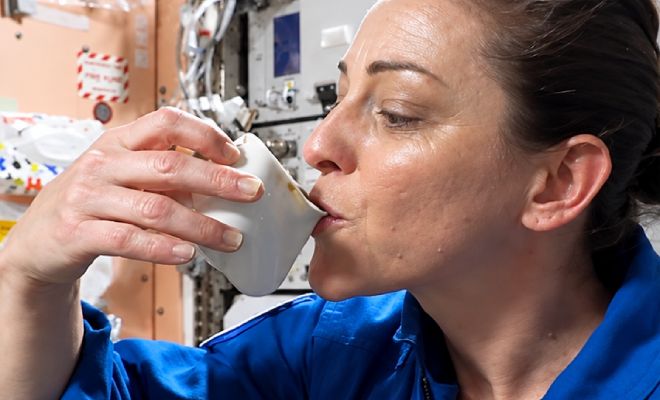
A normal mug has no channel that both guides drink to the lips and holds it at the rim. The Space Cup does. Its shape drives liquid to the edge, where surface tension keeps it.
You can drink with ordinary motions without coffee suddenly floating across the module. Tests showed liquid stayed put during normal drinking moves.
Calling it absolutely spill-proof would be wrong. A hard bump, sharp acceleration, or the wrong conditions can break the balance. Even milk and sugar can change how the liquid behaves.
Why NASA cares about a coffee mug
At first glance the Space Cup looks like a fun experiment. Behind it sits a harder problem than brewing coffee in orbit.
Liquids are everywhere for astronauts: cooling loops, drinking water, waste processing, fuel tanks. In microgravity you cannot predict their motion the way you do on Earth.
In a spacecraft fuel tank engineers need to know where propellant will sit, how it reaches the engine, and how to keep gas bubbles out of the line. In a water-recycling system liquid must move predictably without constant extra hardware.
Capillary research helps design those systems. Every job you can solve passively, with channel or tank shape, is one less mechanical part that can fail.
The Space Cup makes that approach visible: a hard fluid problem solved with a relatively simple object.
What it means
The space mug is interesting because on Earth we let gravity do the work. In weightlessness engineers have to use other physics to get the same result.
On Earth water simply sinks to the bottom of a cup and we barely notice. On orbit you have to design the vessel so the liquid ends up where a person expects it.
All of that for one simple thing: a calm cup of coffee.