Hurricanes flatten cities, sink ships, and look like a force no one can control. But there is one place on Earth they cannot go: the equator. No matter how powerful a storm is, it will never cross that invisible line. Nature built a perfect wall here.
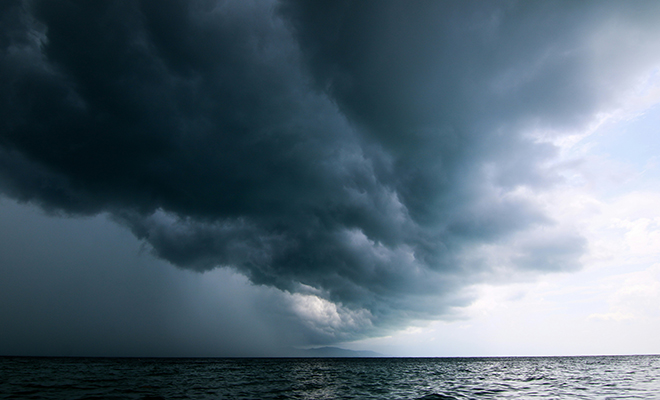
One clarification first: hurricanes, typhoons, and cyclones are the same natural phenomenon. Scientists call them tropical cyclones. The name depends only on where they form.
- In the Atlantic and the eastern Pacific, they are hurricanes;
- In the western Pacific, they are typhoons;
- In the Indian Ocean, they are cyclones.
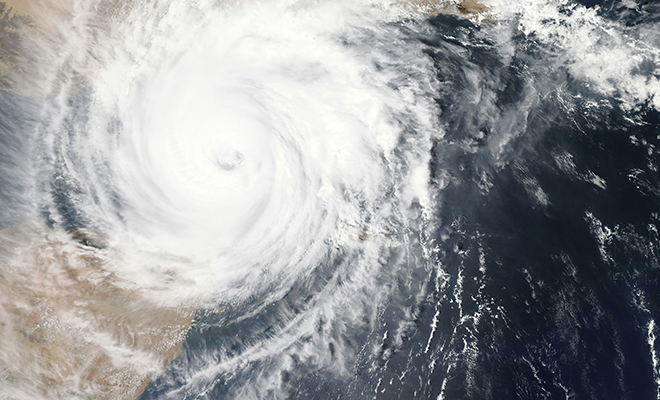
All of these superstorms work the same way. They act like giant turbines fueled by warm, moist air. Hurricanes form over tropical seas where the water temperature rises above 26°C. Air heated by the ocean shoots upward, cools, and turns into thunderclouds. Near the surface, a low-pressure zone forms and pulls in fresh air. Wind then spins the system into a vast vortex.
The Coriolis effect
The direction of that spin is set by the Coriolis effect: an inertial force caused by Earth rotating on its axis.
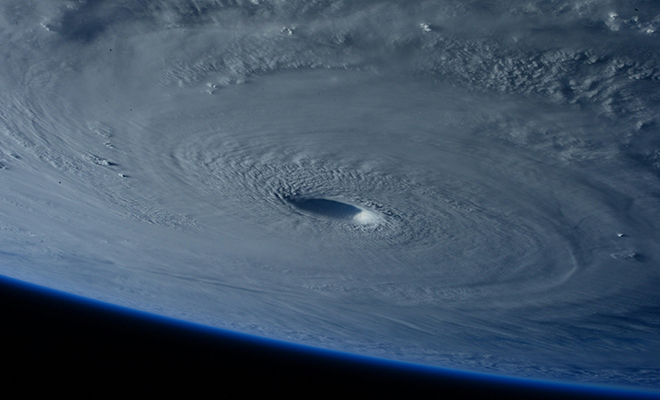
That force splits the planet into two storm zones. In the Northern Hemisphere, Earths rotation makes air masses turn counterclockwise. In the Southern Hemisphere the opposite happens: hurricanes always spin clockwise.
Why hurricanes never cross the equator
Even though hurricanes love warm tropical water, they almost never form within about 300 kilometers of the equator. In the entire observational record there has been only one exception: in 2003, Typhoon Vamei formed just 150 kilometers north of the equatorial line. Anomalies like that happen less than once a century.
At the equator itself, the Coriolis effect is zero. Air currents do not spiral there, so thunderclouds physically cannot spin up into a full hurricane.
For the same reason, storms cannot cross the equator from north to south or south to north. For a Northern Hemisphere hurricane, crossing that line would mean stopping completely, killing its spin, and then rotating the other way.
Physics will not allow it: once a vortex loses the rotational push of the Coriolis effect, its structure collapses and the storm simply dies out.
The equator remains the only safe place in the tropics that giant cyclones can never enter.