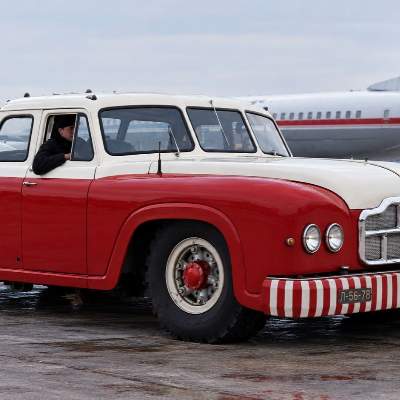
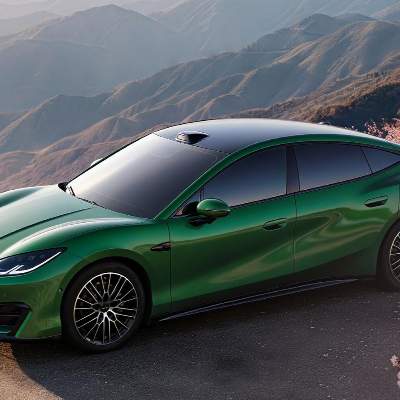
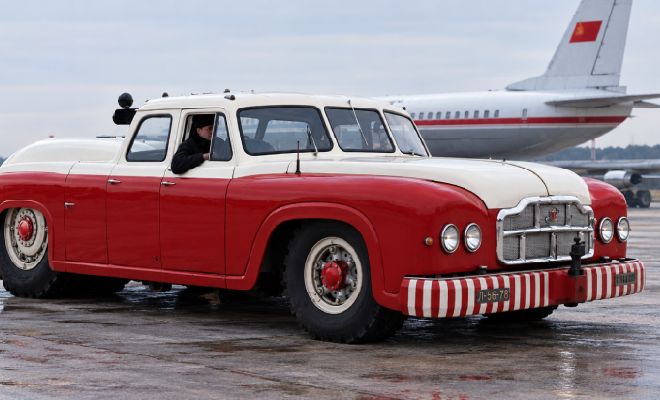
From a distance the MAZ-541 could easily pass for a giant sedan. In reality it weighed more than 28 tons, had a 38.8-liter diesel, and two driver's seats. This strange machine was not built for the record books: it was meant to tow passenger aircraft around the airfield. Only three were made, and almost every detail in their design served a single purpose.
Why an airfield needed such a vehicle
In the late 1950s Soviet civil aviation was moving to larger aircraft. The Tu-104 and other new airliners required more powerful equipment to move around the airfield.
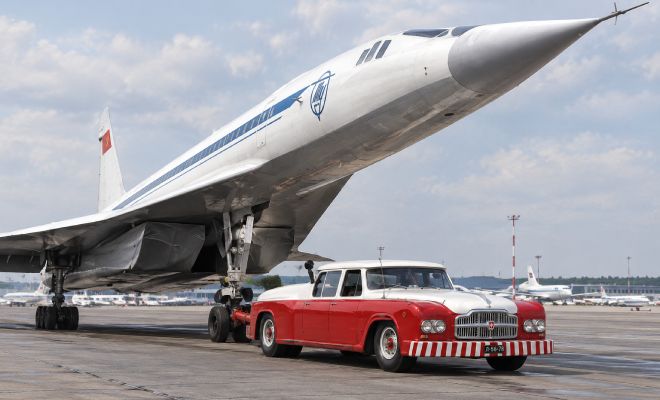
Ordinary tugs were not ideal for the job. The tall MAZ-535, for example, was harder to position directly at an aircraft's nose gear. So in 1956 the Minsk Automobile Plant began developing a special low-profile machine. That is how the MAZ-541 appeared.
Why it looks like a sedan
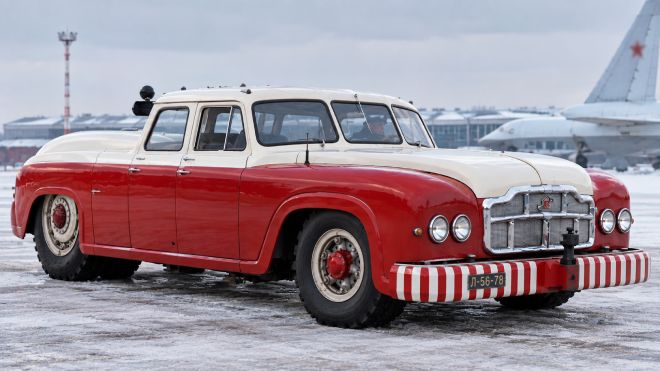
The tug's main feature was immediately obvious. Instead of a conventional truck cab, the designers built a long body with a hood, four doors, and a glazed cabin.
But this was not a passenger car turned into a tug. It happened the other way around: the airport machine was deliberately made to look like a huge car to achieve a low ride height and the ability to work directly in front of an aircraft.
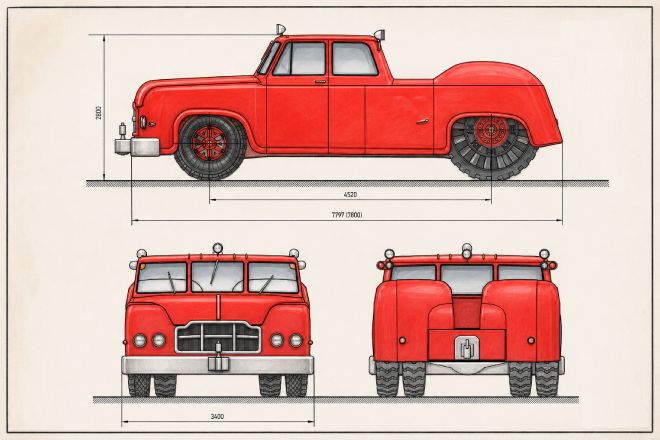
The MAZ-541 was about 7.8 meters long, roughly 3.4 meters wide, and weighed up to 28.2 tons. The heavy body was not a drawback but part of the design: the ballast layout increased wheel grip and helped deliver tractive force.
Why it had two steering wheels
Another detail looks completely unbelievable — two driving positions.
The MAZ-541 could move in both directions without a conventional turn. For a 28-ton tug working next to an aircraft, that made practical sense. The driver did not need to turn the machine around in limited space after completing a maneuver.
So the strange layout was driven not by a desire to astonish but by working conditions.
38.8 liters under the hood
Under the enormous hood sat a 12-cylinder V-shaped D-12A diesel with a displacement of 38.8 liters and 500 hp.
The engine belonged to the large Soviet family of diesels structurally related to the V-2 known from tank technology. That is why the MAZ-541 is sometimes called a machine with a «T-34 engine,» but that is a simplification: the D-12A was not literally a tank engine lifted straight off a T-34.
The tug's top speed was about 30 km/h. It did not need more: its main job was not to go fast but to move a heavy aircraft from a standstill.
An 85-ton aircraft
The calculated towed aircraft weight reached 85 tons. For that the MAZ-541 received a heavy structure, all-wheel drive, and components borrowed from other large equipment. In particular, the rear dual wheels were linked to the MAZ-525 mining dump truck.
Everything on this machine worked toward one goal: to generate enough tractive force at low speed.
Why only three were built
There is another confusion around the MAZ-541. Some sources say 13 machines were produced. In fact 13 tugs were planned under the original order, but only three were actually built.
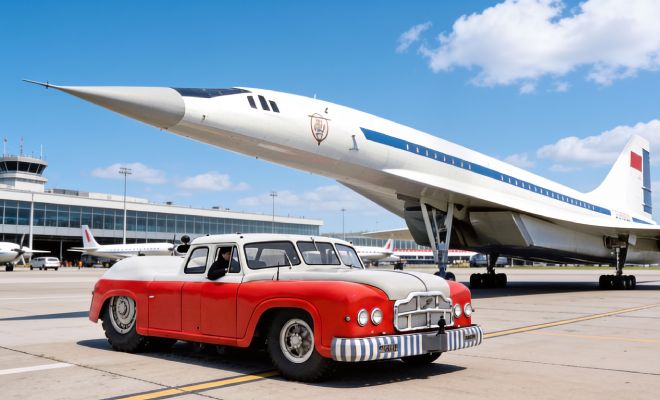
These machines were used at airfields until about 1970. Then service ended, and not a single original MAZ-541 survives today.
The project's short history was not because the design proved useless. Aviation developed quickly, aircraft grew heavier, and requirements for airfield equipment changed. The MAZ-541 was built for a specific era and eventually no longer matched new tasks.
Today it is known mainly from archive photographs. And they create the first deceptive impression: it looks like the largest sedan in history. In fact it was a specialized airport tug that had to look like a car to solve a problem that had nothing to do with cars.