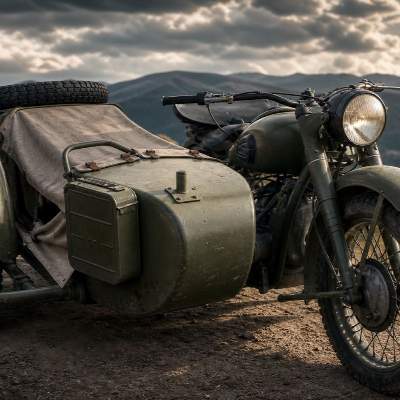
A flying saucer, a wooden giant with a wingspan of nearly 100 meters, a pancake-shaped plane, and a jet fighter meant to ride inside a bomber. It sounds like science fiction, but every one of these machines really existed. They were not built for show: each answered a specific military or engineering problem. Some ideas proved so difficult that they never made it past the test stage.
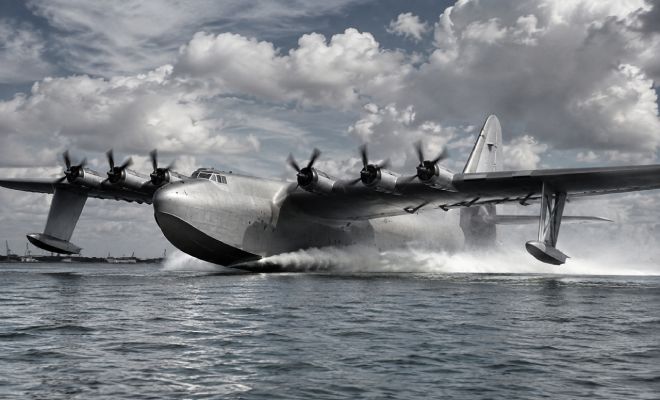
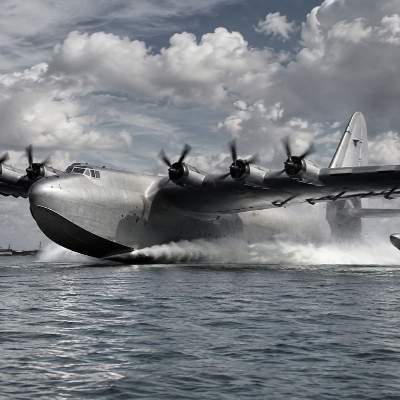
H-4 Hercules: the wooden giant
In 1942, Howard Hughes and shipbuilder Henry Kaiser won a contract to build a huge flying boat for moving troops and equipment across the Atlantic. Because of wartime restrictions, the designers bet on wood. The aircraft was built using Duramold technology from layered birch material.
_1.jpg)
Photo: Clemens Vasters, Hughes H-4 Hercules "Spruce Goose", CC BY 2.0, Wikimedia Commons
The project was originally called HK-1, but after Kaiser left the program in 1944 it became the H-4 Hercules. The wingspan reached 97.5 meters, making it a giant even by today's standards.
The most surprising moment came after the war. On November 2, 1947, Hughes himself took the H-4 out for a test run in Long Beach harbor. During the run the aircraft unexpectedly lifted off the water and flew about 800 meters at roughly 8 meters of altitude. The flight lasted about 30 seconds. The H-4 never flew again.
Today the only surviving example is at the Evergreen Aviation & Space Museum in Oregon.
XF-85 Goblin: a fighter inside a bomber
In the late 1940s, the U.S. military looked for a way to protect long-range bombers from enemy fighters. Conventional escorts often lacked the range. The solution was almost fantastical: a tiny jet fighter would ride inside the bomber.
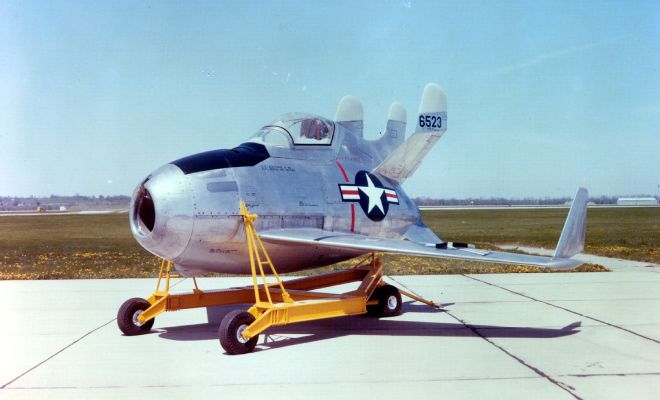
Photo: Egisto SaniInsomnia Cured Here, flickr, CC BY-SA 2.0
The XF-85 Goblin fit inside the bomb bay of a B-36. When the enemy appeared, it was to be lowered on a special trapeze; after the fight the fighter would return to the bomber and hook back onto it.
Tests had to be run with a modified B-29 because the B-36 was not yet available for the program. Launching the Goblin from a B-29 worked, but getting back was the real problem. Turbulence under the fuselage made it hard for the pilot to hit the trapeze precisely. About half the flights ended in forced landings.
One detail says a lot about the project's fate: no XF-85 was ever launched from a B-36. The program was shut down in 1949, and mid-air refueling was seen as the more promising alternative.
VZ-9 Avrocar: a real flying saucer
In the 1950s, the U.S. military actually funded a machine that looked like a classic flying saucer. Canada's Avro created the VZ-9 Avrocar with a round body and a vertical-thrust system.
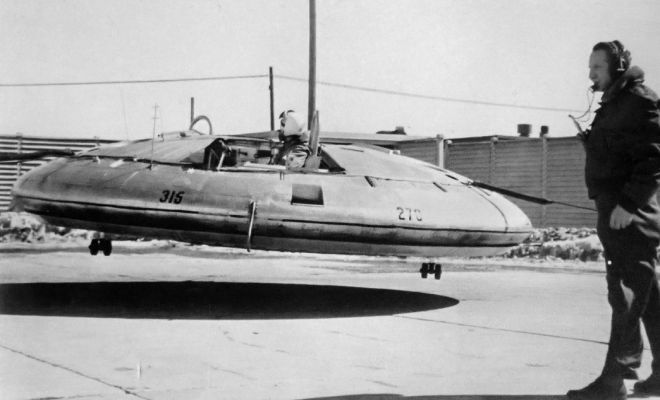
Photo: James St. John - Avro Canada VZ-9AV Avrocar 2, CC BY 2.0, Wikimedia Commons
On paper the idea looked impressive. Reality quickly intervened. Above about three feet the craft became uncontrollable, pitching and rolling violently. Engineers called the effect "hubcapping."
In the end the Avrocar reached only about 56 km/h. Supersonic flight was as far away as the Moon. The project was closed in December 1961. Two prototypes survived; one is now at the National Museum of the U.S. Air Force.
Vought XF5U: the flying flapjack
If the Avrocar looked like a flying saucer, the XF5U resembled a huge pancake with propellers. American designers hoped the shape would combine low takeoff and landing speeds with high cruise speed.
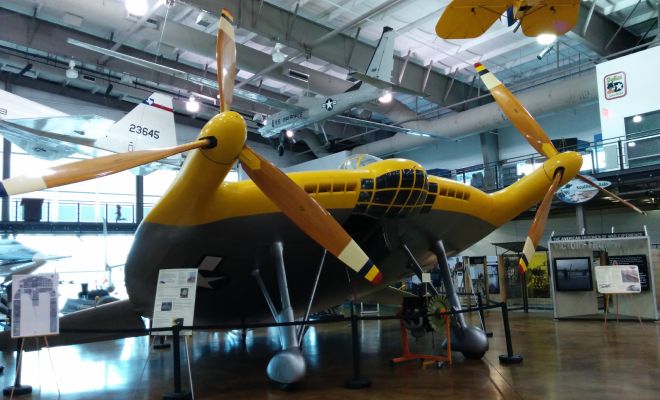
Photo: Eric Urban, CC BY-SA 4.0, Wikimedia Commons
The aircraft was built for the U.S. Navy. Two prototypes were completed, but neither made a full flight. The first underwent ground tests and small hops during taxi runs. Those do not count as real flights.
Problems piled up with vibration, a complex drive system, and the propellers. After World War II the military grew more interested in jet aircraft. The program was canceled on March 17, 1947. Both XF5U airframes were eventually scrapped.
Its predecessor, the V-173 with a similar layout, did fly. Many photos wrongly labeled as a flying XF5U actually show that earlier machine.
Kalinin K-7: an airplane built around a wing
The Soviet K-7 looked as if the designer had dropped the usual fuselage and built the aircraft around a huge wing. The thick central structure was roomy enough to carry people and cargo inside.
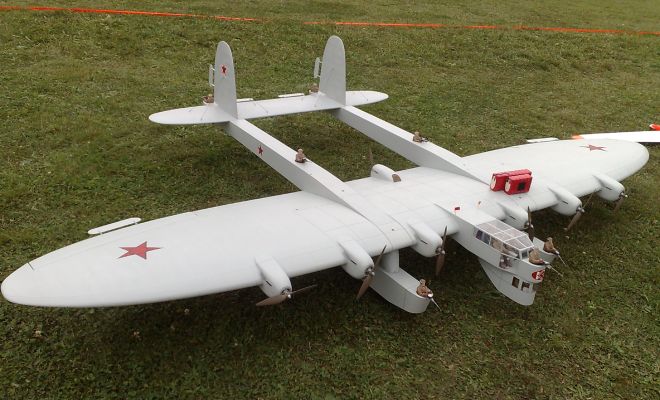
Photo: jagermeister - Ražňany Airport, CC0, Wikimedia Commons
Designer Konstantin Kalinin saw the K-7 as a multi-role machine. Plans called for transport, passenger, and military versions.
The sole prototype began testing in 1933. On November 21 a crash occurred during a routine flight. Twenty people were on board; 15 died. The aircraft was destroyed and the program ended.
The cause was never fully established. One leading theory is failure of the tail structure followed by loss of control, but that cannot be stated as proven fact.
VVA-14: the aircraft that tried to be several machines at once
Robert Bartini's VVA-14 was even more ambitious. It was conceived as an anti-submarine amphibian that could operate from airfields and water, and eventually use vertical takeoff and ground effect.
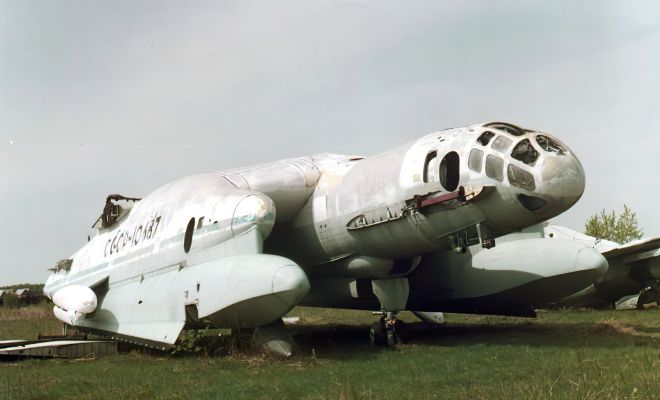
Photo: User:Jno, CC BY 2.5, Wikimedia Commons
The first prototype began flight tests in 1972. But the main idea was never finished: the lift engines needed for vertical takeoff could not be integrated into a complete aircraft.
The prototype continued flying as an experimental aircraft. By 1975 it had logged 107 flights totaling more than 103 hours. After Bartini's death in 1974 the project was gradually wound down. The only surviving VVA-14 is at the Central Air Force Museum in Monino.
Lun: the missile carrier that flew over water
The Lun is hard to call an airplane at all. It was a heavy strike ekranoplan of Project 903, designed to fly at low altitude over water. An air cushion between the wing and the surface created ground effect and increased lift.
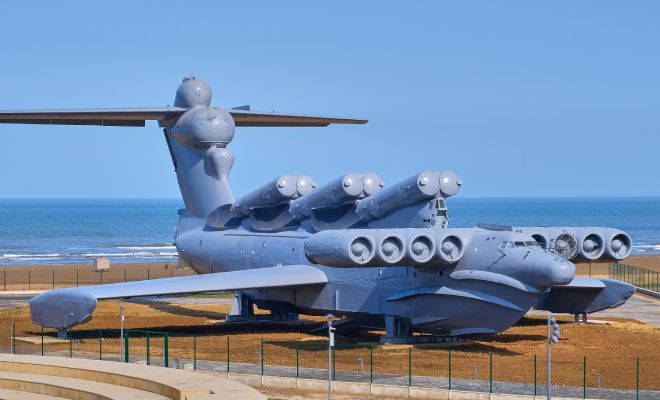
Photo: Vyacheslav Bukharov, CC BY-SA 4.0, Wikimedia Commons
It carried six Moskit anti-ship missiles. At roughly 74 meters long with a 44-meter wingspan, the craft looked more like a sci-fi ship than an aircraft.
Only one Lun was fully built. After the program ended it sat in Kaspiysk for nearly 30 years. In 2020 the giant was moved to Derbent, where it was planned as part of a museum complex.
All these machines grew out of real problems. Some tried to increase range and payload, others sought new ways to take off, still others were meant to change how aviation was used. Most projects lost to simpler, more reliable technology. That is exactly why they fascinate us today: not fantasy drawings, but real experiments that tested the limits of what was possible.