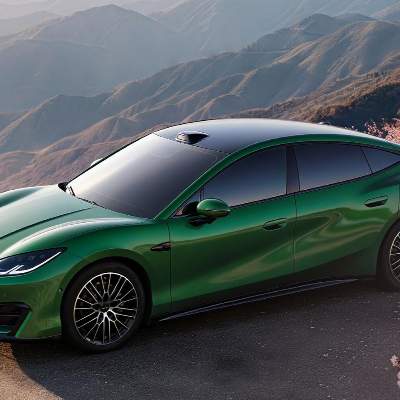
The legendary Pajero left the assembly line in 2021, but Mitsubishi decided it was too soon to write it off. The new generation debuts with a ladder frame, 2.4 diesel, low range, and Super Select 4WD-II. Against modern SUVs that grow quieter, softer, and more complex, the new Pajero took a slightly different path. It kept almost everything old Pajeros were once loved for.
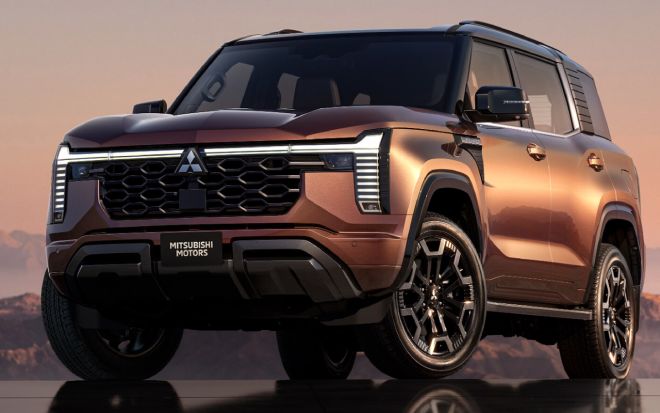
The Pajero returned as more than a name
The first Pajero appeared in 1982 as a vehicle meant to combine full 4x4 capability with passenger-car comfort. Over four generations the model spread to more than 170 countries, and total output passed 3.29 million vehicles. Pajero history also includes 12 Dakar wins, seven in a row.
Now Mitsubishi is bringing the name back as its new flagship cross-country SUV. What matters most here is not the styling with nods to older generations, but what sits under the body.
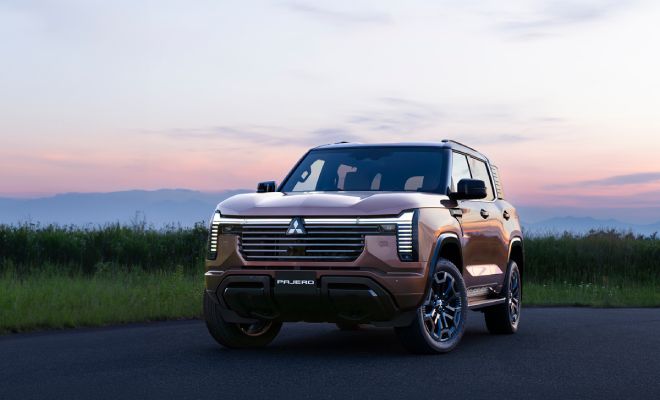
The new Pajero is built on a ladder frame developed from the Triton pickup architecture. The structure was adapted for Pajero character, including body and suspension tuning.
For a large modern SUV, that is already a statement. A frame gives a strong base for heavy loads and off-road work, and Mitsubishi did not stop at ordinary independent suspension all around. Up front are double wishbones; at the rear a five-link setup with a solid axle.
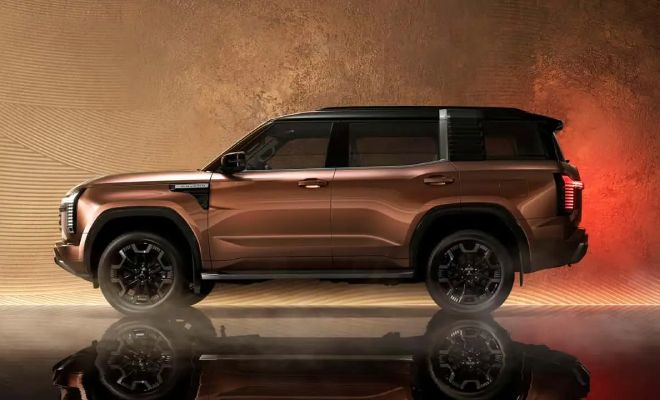
The rear axle especially shows what kind of machine the engineers wanted. The Pajero was meant to be not just a tall vehicle with all-wheel drive, but a machine able to work where pavement ends.
Diesel stayed
At launch, a 2.4-liter turbo diesel with a VGT turbine is announced. Peak torque is up to 480 Nm, though some specs list 470 Nm. It is paired with a new eight-speed automatic with a sport mode.
Mitsubishi has not yet disclosed engine power. Official data also lacks acceleration, top speed, or fuel consumption. So judging the new Pajero’s dynamics on 480 Nm alone would be premature.
For a heavy off-roader, peak power is not the only thing that matters, but how the engine delivers torque at low rpm. That is where a diesel layout makes obvious sense: it provides the pull needed without constantly revving the engine, while the eight-speed auto gives a wider spread of ratios for road and trail.
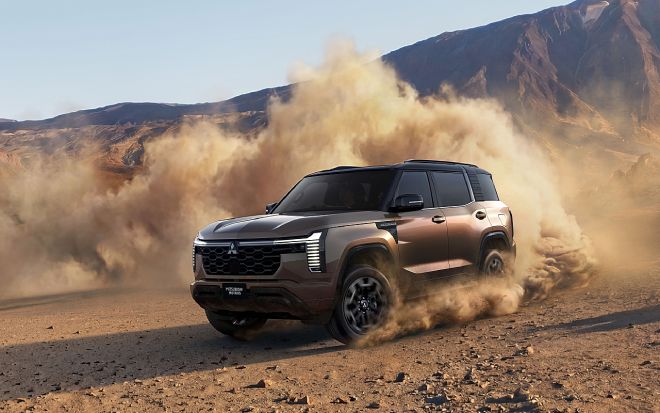
It is the combination of diesel, frame, and low range that sets the Pajero apart from most large SUVs today, which focus mainly on on-road behavior.
Super Select is still here
The most recognizable technical part of the Pajero is still in place—Super Select 4WD-II.
In 2H mode the vehicle uses rear drive. 4H engages all-wheel drive, 4HLc locks the center differential, and 4LLc adds low range and locking.
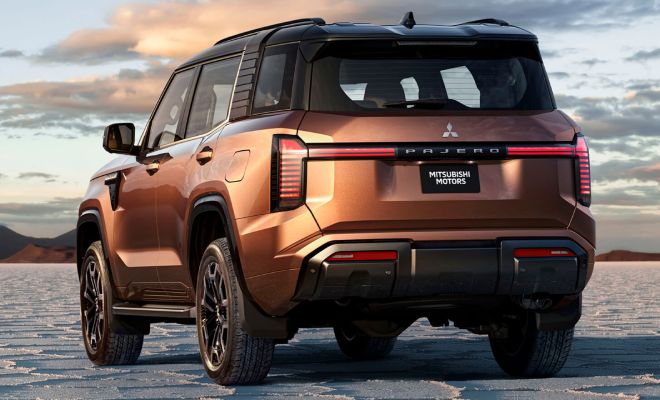
The last mode is not for a pretty screen icon. Low range increases wheel torque and lets you move more slowly over difficult terrain when normal gears are no longer enough.
On top of SS4-II sits S-AWC. The system combines Active Yaw Control, stability control, traction management, and ABS. Seven modes are provided for different surfaces: Normal, Eco, Gravel, Snow, Mud, Sand, and Rock.
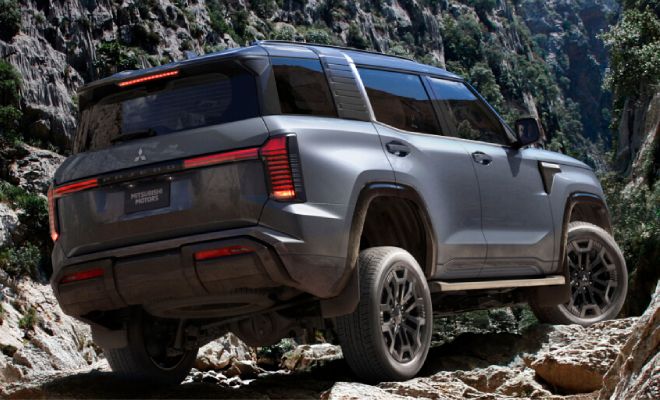
The result is a very Mitsubishi setup: electronics help the driver, but the mechanical side is still built for serious work.
Geometry matters more than surface shine
The new Pajero is sizable: 4,920 mm long, 1,925 mm wide, and 1,910 mm tall. Wheelbase is 2,870 mm.
Ground clearance is 230 mm on 20-inch wheels. Approach angle is 30.4 degrees, ramp breakover 22.6 degrees, departure 25.8 degrees. Weight distribution front to rear is 52:48.
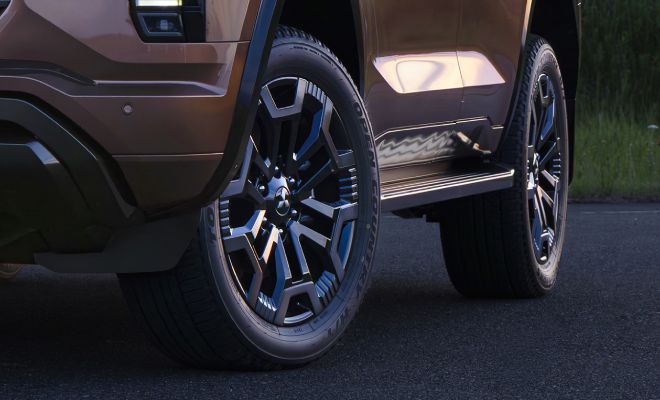
For an off-roader, those numbers say more than grille design. High clearance reduces the risk of scraping the underbody on loose ground, while approach and departure angles define how steep a slope or obstacle the vehicle can take without hitting bumpers.
At the same time Mitsubishi worked separately on what usually pairs poorly with a big body-on-frame machine: comfort. Reinforced body mounts should cut vibration on broken roads, and suspension was tuned for long trips on poor surfaces.
Seven seats and acoustic glass
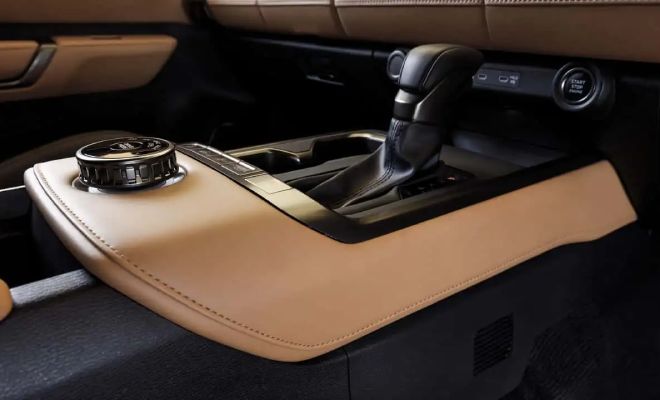
Inside, the new Pajero looks nothing like an old-school utilitarian off-roader. There are three rows and seven seats. The second row slides 150 mm, and the third is sized for adult passengers. Three-zone climate control and ventilation for front and second-row seats are included.
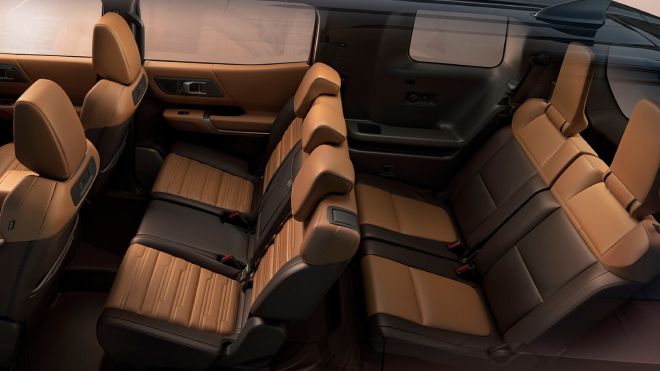
Sound insulation got its own attention: acoustic glass is fitted not only in the windshield but in the front and rear doors.
That fits the original Pajero idea. The vehicle should reach places a normal crossover will not go, but getting there can take hours. Comfort here is not decorative add-on to off-road hardware; it is part of the concept.
Old gauges went digital
There are nods to earlier Pajeros in the cabin too. The horizontal dashboard architecture recalls the first generation, and the signature triple gauge cluster became the digital Multi Meter.
It can show altitude, heading, temperature, longitudinal and lateral tilt angles, and Active Yaw Control status. For a normal city trip that is mostly curiosity; off-road, those readings actually matter.
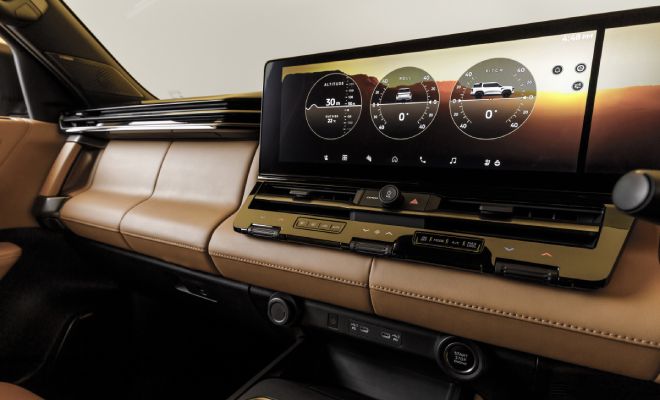
The main display uses two screens up to 14.3 inches. Mitsubishi still keeps the smartphone integration expected in modern cars.
.jpg)
There is also a camera more interesting than another infotainment stack. The 3D Multi Around Monitor uses four cameras to build an image of the space around the vehicle. A separate mode shows the road directly ahead and under the front of the car. When 4HLc or 4LLc is engaged, it can activate automatically.
For the city that helps with parking. On rocky tracks it lets you see what the driver cannot physically see over the hood.
When the new Pajero will arrive
Production of the new Pajero will be organized in Thailand. Thailand is the first market; then the vehicle will launch in Japan and Australia in Mitsubishi’s fiscal 2026. From fiscal 2027 the company plans to sell the model in about 100 countries, including ASEAN, Latin America, and Middle East markets.
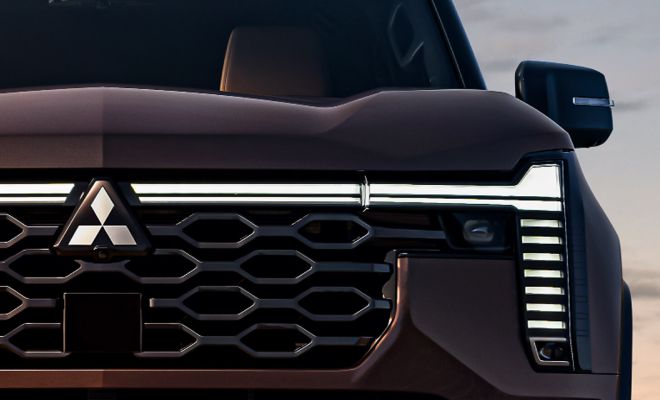
Russia is not yet named on the official market list. So there is no exact date for the new Pajero to appear there. Price is also unannounced: Mitsubishi did not reveal cost at the world premiere.
Mitsubishi could simply have taken a familiar name and built another large comfortable SUV. Instead the company kept the frame, diesel, solid rear axle, Super Select 4WD-II, and low range, then added a modern cabin, cameras, and electronic assists on top.
The new-generation Pajero is clearly not trying to live in the past. But Mitsubishi also did not pretend the past no longer matters.