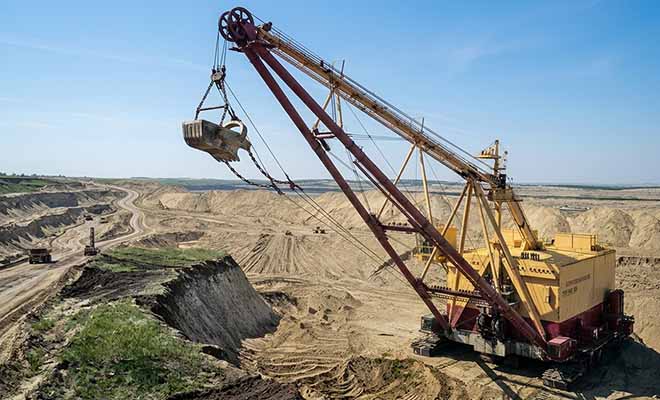
Soviet construction projects were staggering in scale. Canals were cut across the country, roads were built through half a continent, and millions of cubic meters of overburden were removed from open-pit mines. For work like that, Soviet engineers built giant excavators. The most famous is the legendary Soviet ESh-100/100. Workers quickly nicknamed these machines the «Shagar.»
Why the USSR needed walking machines
The main job of the Soviet walking excavator is stripping overburden. To reach coal or iron ore seams in open pits (for example in the Kansk-Achinsk or Kuznetsk basins), you first have to dig up and move millions of tons of useless topsoil and clay.
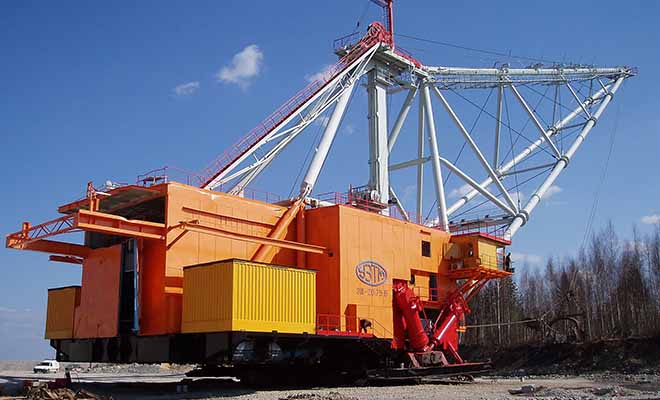
A conventional tracked excavator, under the pressure of its own enormous weight, inevitably sank and bogged down in soft quarry soil. A track applies 1.5–2 kg/cm² to the ground, which is critical on loose material.
Engineers at Uralmash and the Novokramatorsky Machine-Building Plant (NKMP) solved the problem in a radical way:
- Working position (digging): the excavator stands on a giant round steel frame — a «support shoe» (platform) up to 18 meters in diameter. Because of the huge contact area, ground pressure drops to 0.4–0.8 kg/cm² (less than a person's foot). The machine does not sink even in swampy ground.
- Movement: when the excavator needs to change position, the walking mechanism takes over.
How the walking process works
Along the sides of the excavator body sit two giant steel «skis» (supports). Inside the machine are powerful hydraulic cylinders or hydraulic crank mechanisms.
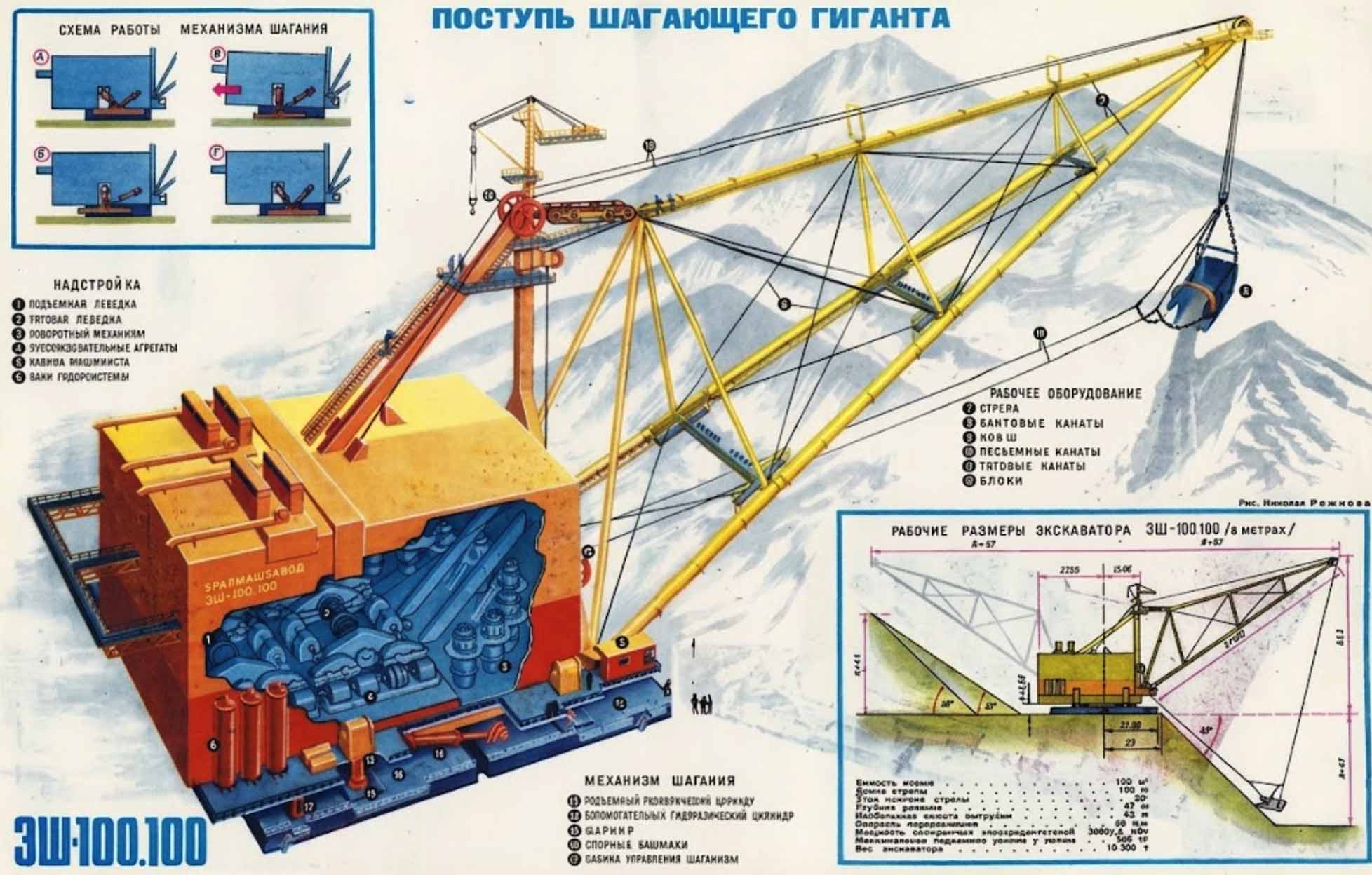
- The ski supports drop to the ground on either side of the machine.
- Hydraulics lift the entire multi-ton body together with the base platform off the ground and shift it slightly forward.
- The machine settles back onto the base plate, but one and a half to two meters farther along.
- The skis are pulled up in the air and prepare for the next step.
How far the Shagar can travel on its own
Despite looking clumsy, Soviet walking excavators were designed to be fully self-mobile inside quarries.
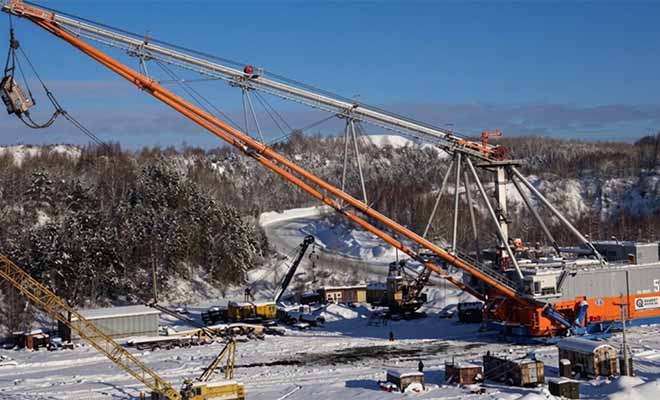
- Travel speed: average movement speed for a Soviet ESh is 60 to 200 meters per hour. One «step» covers 1.2 to 2.4 meters.
- Range and distance: in theory there is no limit — as long as there is electric power and working hydraulics, the machine can keep walking.
- Real relocations: Soviet mining history records dozens of cases when walking excavators were moved under their own power from one quarry to another over distances of 10, 20, and even 40 kilometers.
How a giant was moved over long distances
Relocating a Shagar to a new work site under its own power was a full operation, taking from several weeks to a couple of months. All Soviet ESh units ran on high-voltage electricity (6,000–10,000 volts). A flexible armored cable was towed behind the excavator on a special trailer or drum, and temporary power lines and mobile transformer substations were installed along the route.
- Route preparation: the excavator's path was leveled with bulldozers, and ditches and shallow rivers were filled with temporary earthen dams.
- Crossing roads: if the route crossed a highway or railway, a thick cushion of rock and earth was piled on the rails or asphalt so the skis of the 1,000-ton machine would not crush the surface.
The walking drive let the USSR develop some of the world's largest open-pit coal and ore mines, where classic tracked equipment or haulage for overburden removal was technically impossible or economically unviable.