Open-pit mines were until recently the last stronghold of heavy diesel haulage. In conditions where a machine must climb steep grades with hundreds of tons of rock, batteries seemed impossible. However, China's Zijin Longking broke that stereotype with the ZL230E — the world's largest fully electric battery-powered mining dump truck.
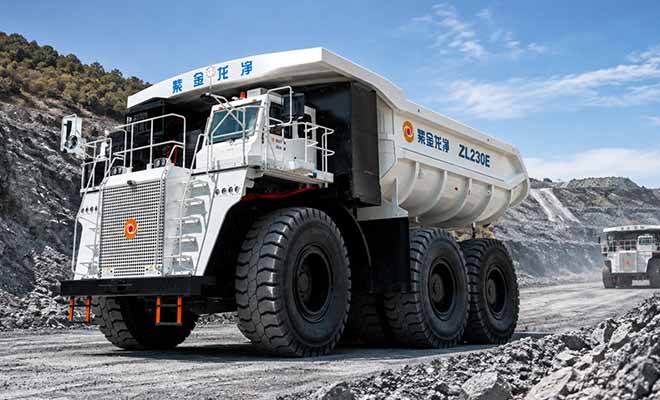
How the world's largest electric dump truck is built
The ZL230E battery pack holds about 1,400 kWh (1.4 MWh). For comparison, that is enough energy for a passenger EV to drive roughly 8,000 kilometers without a single stop. Engineers also solved the main downtime problem. Thanks to ultra-powerful megawatt charging stations, the battery charges from 10% to 90% in just 25 minutes — barely enough time for a driver change or a safety briefing.
The main secret of the ZL230E's efficiency lies in how open-pit mines work. A typical cycle is a descent to the pit floor empty and a heavy climb back up with dozens of tons of ore.
When a dump truck loaded with 230 tons of ore descends a switchback, the electrodynamic braking system kicks in. Traction motors switch to generator mode, converting the heavy machine's kinetic energy into electricity and sending it back to the battery.
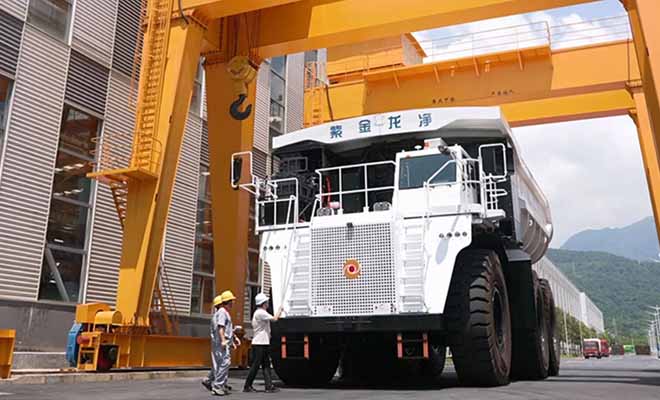
On deep pits with long descents, recuperation can offset up to a third of the energy needed for the next climb.
ZL230E dump truck specifications
- payload capacity — 230 tons.
- gross weight — 350 tons.
- body volume — 125 m³.
- combined power of two electric motors — 1,600 kW (about 2,175 hp).
- drive architecture — multi-axle independent with distributed traction.
Where the ZL230E beats BelAZ
The Chinese company bet on savings. The owner does not need to buy dozens of tons of diesel fuel every day. Electricity costs are far below diesel, and the absence of an internal combustion engine eliminates regular oil changes, filter replacements, and complex piston-group repairs.
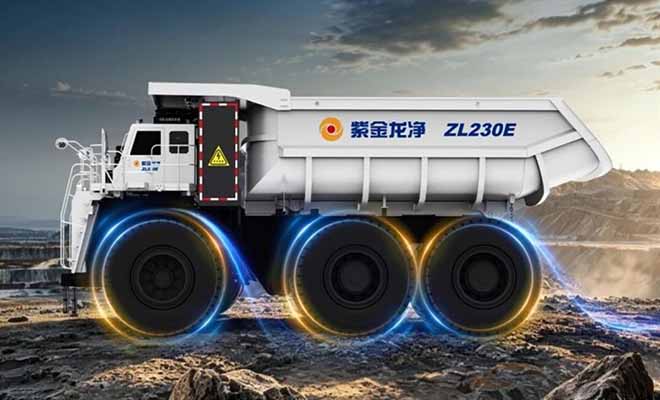
The descent is essentially free. When a dump truck loaded with 230 tons of ore rolls down to the pit floor or along a switchback, the wheel motors work as generators. The recuperation system converts the heavy machine's kinetic energy into electricity, returning up to 30% of charge to the battery. A BelAZ in the same conditions simply burns brake pads and dissipates energy as heat.
Moreover, the absence of exhaust gases is critical at the bottom of deep pits, where natural ventilation is poor and diesel smoke reduces visibility and threatens workers' health.
Instant torque and high efficiency also played a role. Electric motors deliver maximum torque from the first revolutions, making it easier to pull away on steep grades without delay or wheelspin.
Where the electric dump truck falls short of BelAZ
Naturally, the ZL230E has drawbacks too. The first is a rigid tie to infrastructure. A diesel BelAZ can be refueled anywhere at the mine in minutes with a mobile fuel truck. The ZL230E requires expensive megawatt charging stations and high-capacity power lines run directly to the quarry.
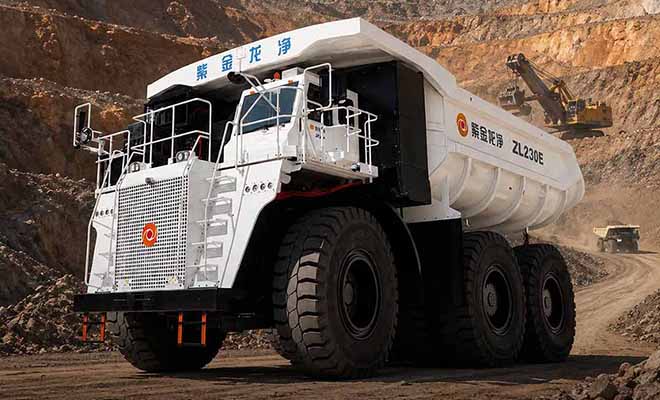
- Vulnerability in severe cold: in the Far North and Siberia (below -30°C and -40°C), where BelAZ trucks operate in large numbers, lithium-ion batteries lose capacity and charging speed sharply. The electric dump truck would need huge energy expenditure just to keep the battery warm.
- Dead weight of the battery pack: the enormous battery block weighs dozens of tons. That mass counts toward gross vehicle weight, reducing payload compared with a diesel machine of similar size.
- Maximum weight limit: the Belarusian plant builds giants with payloads up to 450 tons (BelAZ-75710). An electric equivalent at that scale would require a battery of incredible size and weight, which is not yet technically practical.
Looking ahead, the ZL230E is set to become driverless. The cab and chassis are prepared for autonomous driving systems, which could turn the entire quarry into a single robotic complex.