A standard truck cannot haul a rocket to the launch pad, a standard plane cannot fit another aircraft’s wing in its cargo hold, and a standard ship cannot lift an oil platform whole. So engineers built machines that can do exactly that. From Russia’s TM-140, which needs no roads, to the giant Pioneering Spirit and the 450-ton BELAZ: seven real machines whose design looks like science fiction until you learn what they were built for.
TM-140: The Russian All-Terrain Vehicle That Needs No Road
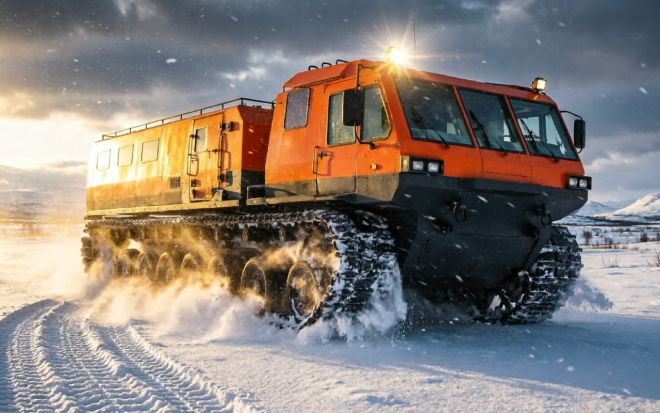
From the outside, the TM-140 looks like a vehicle from a film about an expedition to another planet. In reality it is a tracked Russian snow-and-swamp vehicle from Kurganmashzavod, designed for work in hard-to-reach areas.
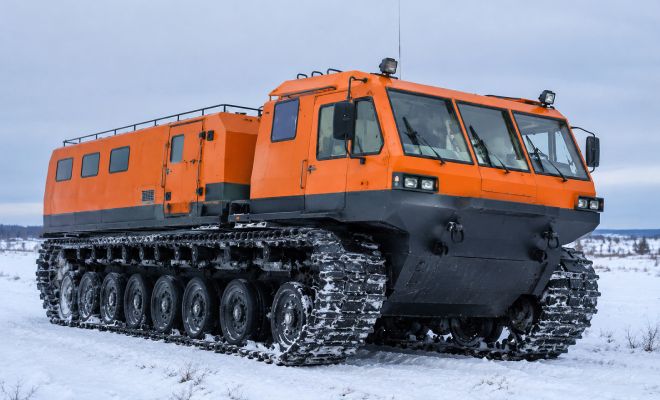
The TM-140 is used to transport people, cargo, and equipment. Among its users are emergency rescue units of Russia’s Ministry of Emergency Situations in the North. In 2025 such machines covered more than 2,300 km of rough terrain during the Safe Arctic exercises, including routes at temperatures down to −45 °C.
The all-terrain vehicle weighs about 11 tons and can carry up to 4 tons of cargo. On firm ground it reaches up to 45 km/h, and on water it moves at up to 4 km/h. A sealed hull and wide tracks let it cross swamps, deep snow, and water obstacles.
This is not museum hardware. In September 2026 Kurganmashzavod delivered another TM-140 to a customer in Yakutia for geological survey work. The machines also serve rescuers in Russia’s northern regions.
NASA Crawler-Transporter: The Truck for Rockets
If an ordinary truck hauls cargo, the Crawler-Transporter hauls a rocket. NASA uses these giant tracked platforms to move rockets from the Vehicle Assembly Building to the launch pad. The modern Crawler-Transporter 2 was upgraded for the Space Launch System and the Artemis program.
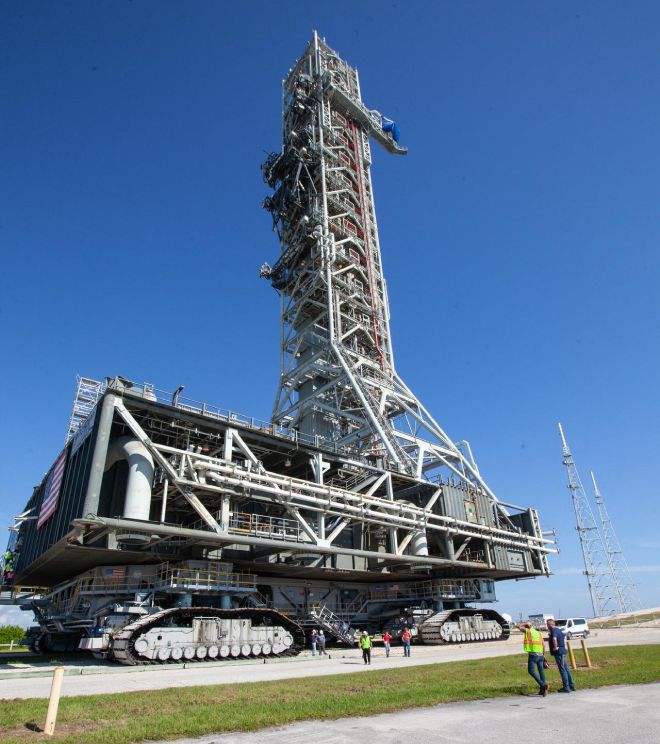
The scale is impressive even by launch-site standards. The machine weighs about 6.6 million pounds — roughly 3,000 tons — and after modernization its load capacity is 18 million pounds, or about 8,165 tons. When carrying a rocket, the transporter moves at less than 1.5 km/h.
In January 2026 Crawler-Transporter 2 delivered the Artemis II rocket to the launch pad. After the rocket returned to the assembly building, it was used again to move it. NASA continues operating the machine as part of the Artemis program.
Speed does not matter here at all. The Crawler-Transporter must slowly deliver a multi-thousand-ton structure to the pad while keeping it in working position.
Airbus BelugaXL: The Plane Whose Fuselage Had to Be Inflated
The BelugaXL looks as if someone enlarged the upper half of an ordinary passenger jet. In fact its unusual shape came from a practical problem: Airbus needed an aircraft capable of carrying large parts of other airplanes.
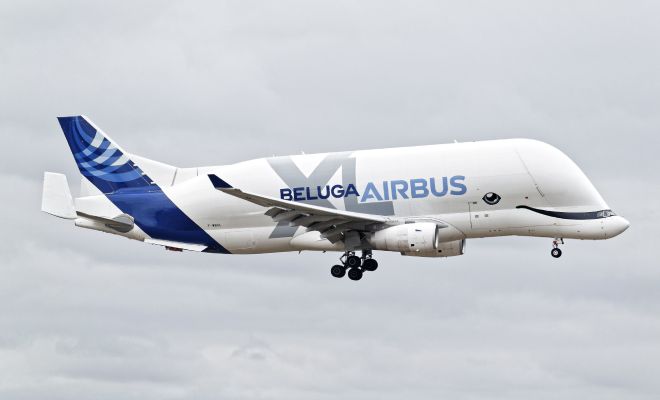
Photo: Dylan Agbagni, CC0, Wikimedia Commons
The BelugaXL was built to deliver components between Airbus production sites in Europe. Its cargo hold fits parts that cannot be moved by a conventional transport aircraft.
The aircraft is based on the A330-200 but received a fully reworked upper fuselage and a huge cargo bay. Maximum payload is 51 tons; length is 63.1 meters. Inside it can carry, for example, an A350 fuselage section or two A350 wings about 30 meters long.
Airbus operates six BelugaXL aircraft. The last entered service in June 2024. All are used to move components between the company’s European production sites.
The result is an aircraft that looks strange precisely because it was designed not for passengers but for moving airplanes in pieces.
Pioneering Spirit: The Ship That Takes Platforms Whole
Pioneering Spirit looks more like a floating industrial structure than an ordinary vessel. It is 382 meters long and 124 meters wide, with a huge opening in the bow through which the ship approaches offshore platforms.
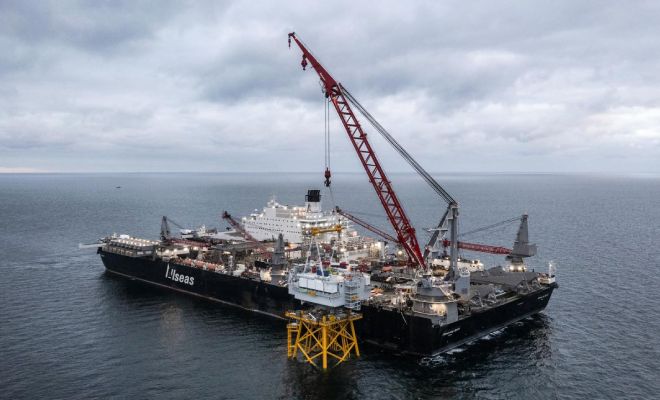
The vessel is designed to install and remove large oil and gas platforms. Instead of dismantling the topside at sea into many pieces, Pioneering Spirit can lift it whole.
After upgrading its lifting system, it is rated for topsides weighing up to 60,000 tons. For platform jackets, the stated capacity is up to 20,000 tons. The ship has 12 thrusters and a dynamic positioning system.
One of the most complex operations for such a machine looks almost unbelievable: the ship approaches a platform, guides the structure into a special opening, and lifts the multi-thousand-ton topside above the water.
Caterpillar 797F: The Mining Truck Too Big for an Ordinary Road
The Caterpillar 797F looks like an enormous truck until a person stands beside it. Full operating weight reaches 623.7 tons, rated payload is 363 tons, and the engine develops 4,000 hp.
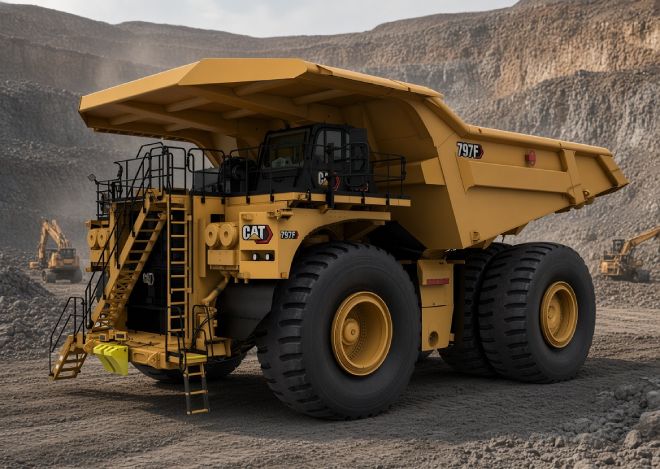
The 797F is not meant for public roads. Its workplace is large open-pit mines, where it constantly moves huge volumes of rock between the face and the dump site.
At such scale, familiar automotive specs become secondary. What matters is how many tons the machine hauls per trip and how efficiently it can run in a continuous cycle.
BELAZ-75710: 450 Tons of Cargo in One Trip
The BELAZ-75710 looks as if an ordinary mining truck was simply scaled to the limit. But its design is far more interesting than its size.
The Belarusian machine is built to haul overburden in deep open pits. Payload is 450 tons, operating weight is about 360 tons, and gross weight with load reaches roughly 810 tons. Length is 20.6 meters, width about 9.8 meters.
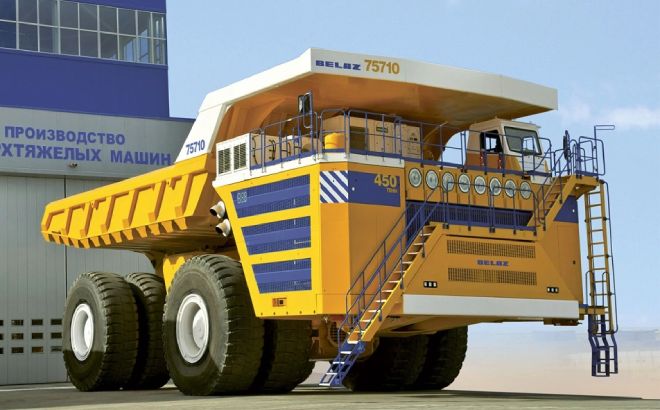
The powertrain consists of two diesel engines with a combined output of about 4,600 hp. An electric transmission sends energy to four wheel motors.
The BELAZ’s main feature is not only size but the steering layout. Instead of a traditional articulation joint, it uses steerable axles. That made it possible to build a machine of such payload capacity that can still work on existing mine haul roads.
SPMT: The Platform That Can Drive Sideways
A self-propelled modular transporter (SPMT) looks like several rows of wheels joined into one huge low structure. It may have no familiar body or cab at all.
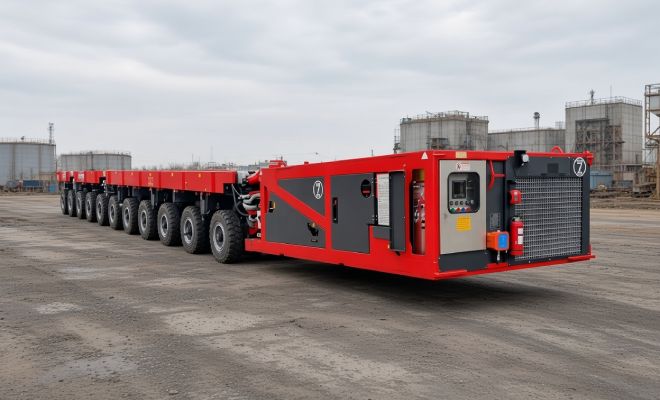
SPMTs are assembled from individual modules for a specific load. Each module has its own drive and control system, and the wheels can turn 360 degrees. So the platform can move not only forward and backward but sideways, and perform complex maneuvers in a limited space.
Such systems move heavy industrial structures, bridge sections, parts of power plants, and other cargo that cannot be transported by ordinary vehicles.
Instead of one giant truck you get a construction set: the required number of modules are linked together, the load is placed on top, and the entire platform is controlled as a single machine.
All these machines share one trait: their appearance is dictated by the job. Some need no roads; others must carry rockets and aircraft parts; still others work with loads measured in thousands of tons. Here engineers first receive an impossible task — and only then invent a machine capable of solving it.