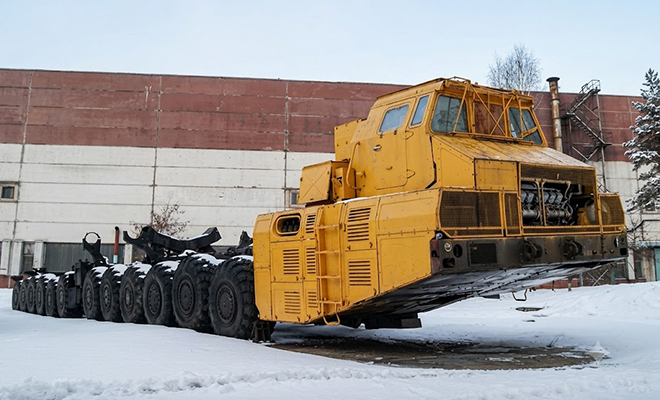
In the mid-1980s the Minsk Automobile Plant built a true engineering colossus. The MAZ-7907 stunned with nearly everything: almost 29 meters long, 24 wheels on 12 axles, and a payload of about 150 tons. Engineers did not build it for records. The tractor did its job perfectly, yet it was excessive for its time.
How the MAZ-7907 truck was built
Work ran in a special design bureau at the Minsk plant under legendary designer Boris Shaposhnik. To meet the brief, engineers dropped familiar technical solutions.
The MAZ-7907’s standout was its unusual powertrain. Instead of a classic mechanical transmission it used a gas turbine of about 1,250 horsepower. It did not drive the wheels directly; it acted as a powerful power station feeding motor-wheels.
Each wheel had its own electric motor. Similar tech is common now, but in the mid-1980s the layout looked revolutionary. Handling was equally impressive. Despite nearly 29 meters of length, 16 wheels steered. That let the huge transporter take corners far more easily than machines of that size usually can.
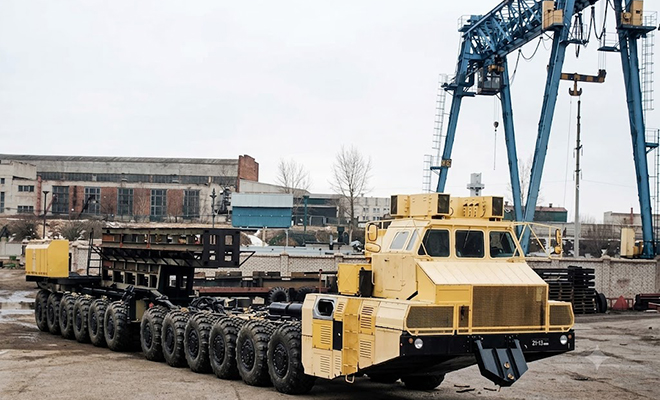
Tests showed the engineers had built something unique. It moved confidently on public roads and rough off-road terrain, matching military requirements.
Why the MAZ-7907 was needed
Designers faced a state-level task: build a chassis for the prospective Tselina-2 mobile missile complex, meant to carry the RT-23 Molodets intercontinental ballistic missile. The new weapon was so heavy that existing transporters could not handle the load.
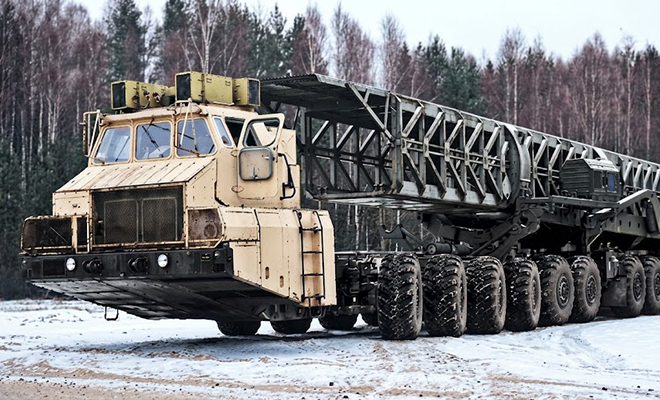
Every MAZ-7907 test went perfectly. Serial production and years of service seemed ahead, but history went another way. In the late 1980s strategic arms cuts began, and work on Tselina-2 stopped. The machine the giant transporter was built for never entered service.
Need for the MAZ-7907 vanished almost as soon as trials ended. Only two prototypes were ever built. The story of one of Soviet automotive engineering’s most ambitious projects could have ended there. A few years later, fate gave the machine one more chance.
The last run was nothing like what the engineers planned
In 1996 one MAZ-7907 left the hangar again. This time it would not haul a secret missile. Workers loaded a ~90-ton excursion steamer onto its platform to move it from the Berezina River to Lake Naroch in Belarus. For a machine built only for military work, that became its only civilian mission.
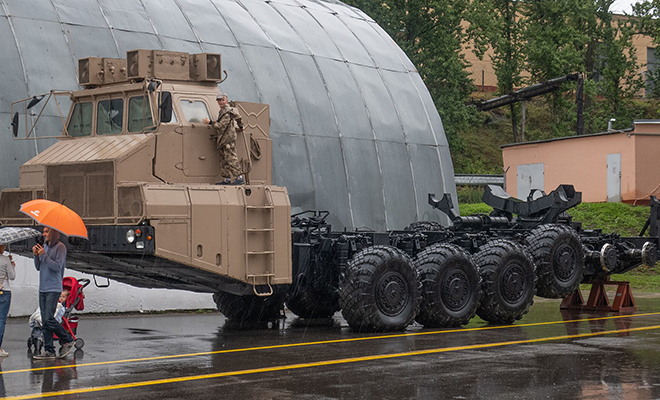
The haul succeeded, and it was also the legendary transporter’s last. Serious faults in the complex electric transmission showed up on the route. After the job, nobody repaired the unique machine. The MAZ-7907 never took to the road again.
Where the legendary MAZ-7907 is today
One example of the unique transporter survives. It stands on the Minsk Automobile Plant grounds and ranks among the oddest machines Soviet engineers ever built.
The second prototype was later used for spare parts, so it could not be preserved whole.